
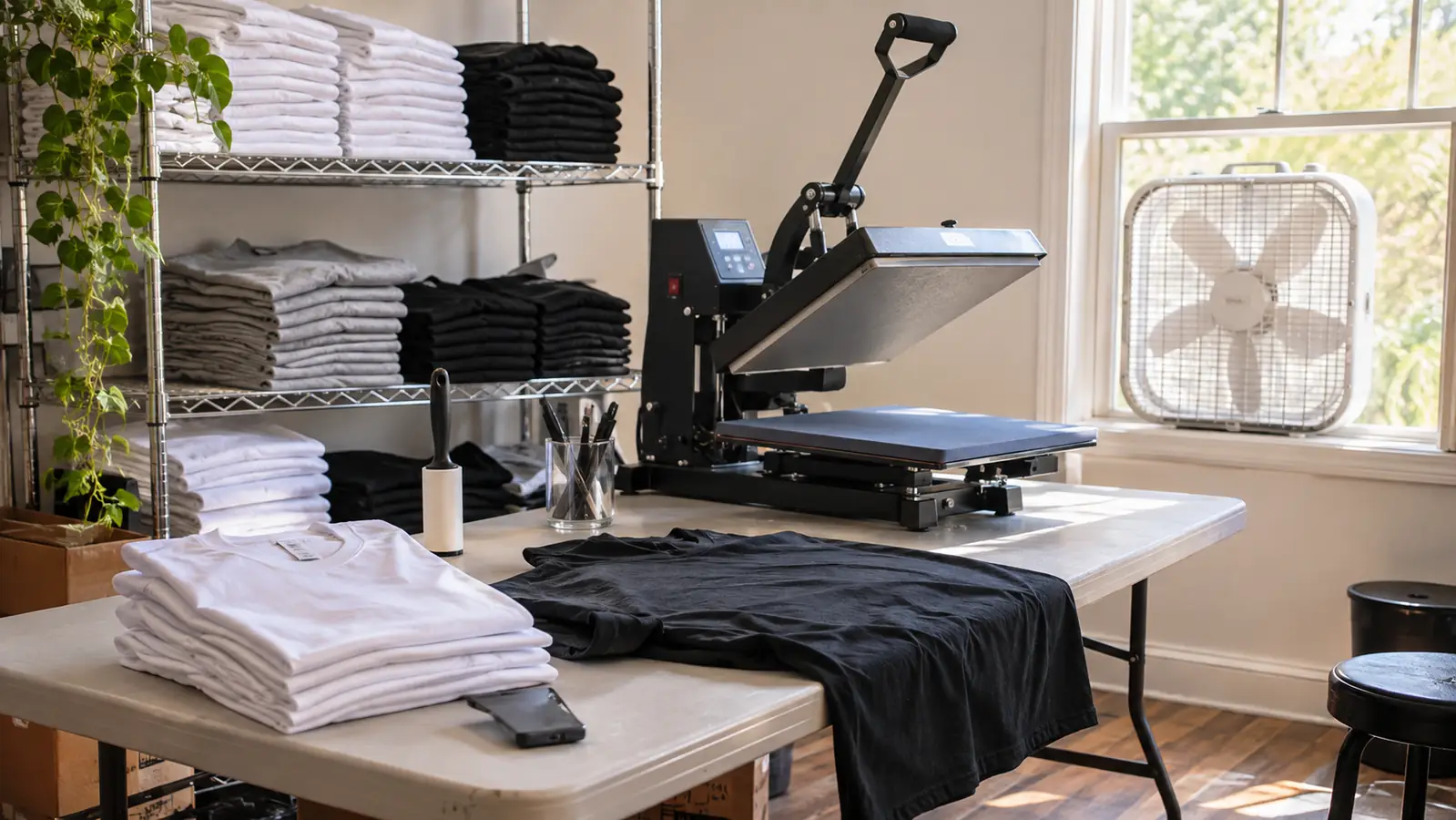
The first project I ruined with a heat press was a zippered pouch for a coworker's birthday. I laid it flat, pulled the handle down, counted to twenty, and lifted. The fabric on either side of the zip was perfect. The narrow strip running right along the teeth was a pressed-in mess, because the hardware had pushed up into the platen and taken all the pressure while the fabric around it got almost none. I had been pressing for about a year at that point, working out of the spare bedroom of my house in Albuquerque, and it had never occurred to me to think about what was underneath the blank. A friend who presses team shirts told me to put a pillow under it, or fold a towel if I was feeling cheap. I did both. The VCHOMY Heat Press Pillow Kit is the one that stayed on my table.
The short answer: the VCHOMY kit wins on repeatability, and a folded towel wins on the fact that you already own one. If you press the occasional shirt for family, a towel folded to roughly the right thickness will get you through it. If you are taking orders, even informal ones for school staff or a youth sports team, the towel will eventually let you down in a way that costs you blanks. A towel is a different thickness every time you fold it, it holds heat and moisture, and it has no rating for what a press actually does to it. The kit gives you four fixed sizes with a Teflon surface and a 600 °F upper temperature rating, so the one variable that used to change every session stops changing.
| VCHOMY Heat Press Pillow Kit | A Folded Towel | |
|---|---|---|
| Pressure over a zipper or seam | Lifts the low areas so the platen meets the whole panel at one level | Bunched fabric creates its own high and low spots |
| Thickness from one item to the next | Four fixed sizes, identical every time you pick one up | Changes with every fold, and compresses through a long run |
| Heat tolerance | Rated to 600 °F with a Teflon surface | Cotton scorches, holds moisture, no rating at all |
| Small curved items | 5 x 5 inch and 5 x 15 inch pieces fit sleeves and straps | One folded towel is too bulky to sit inside a sleeve |
| Cleanup between items | Waterproof, reusable, wipes clean, no lint | Absorbs moisture, sheds lint, goes flat over time |
| What you already have on hand | Has to be ordered and waited for | Already in the linen closet |
| Adjustable thickness | Fixed, no fine tuning | Add a layer or remove one to match the item |
| Coverage on a large flat panel | Largest piece is 12 x 15 inches | A bath towel covers more area |
| Best for | Repeat orders and anything with hardware on it | One-off pressing on flat items |
Where the VCHOMY Kit Wins
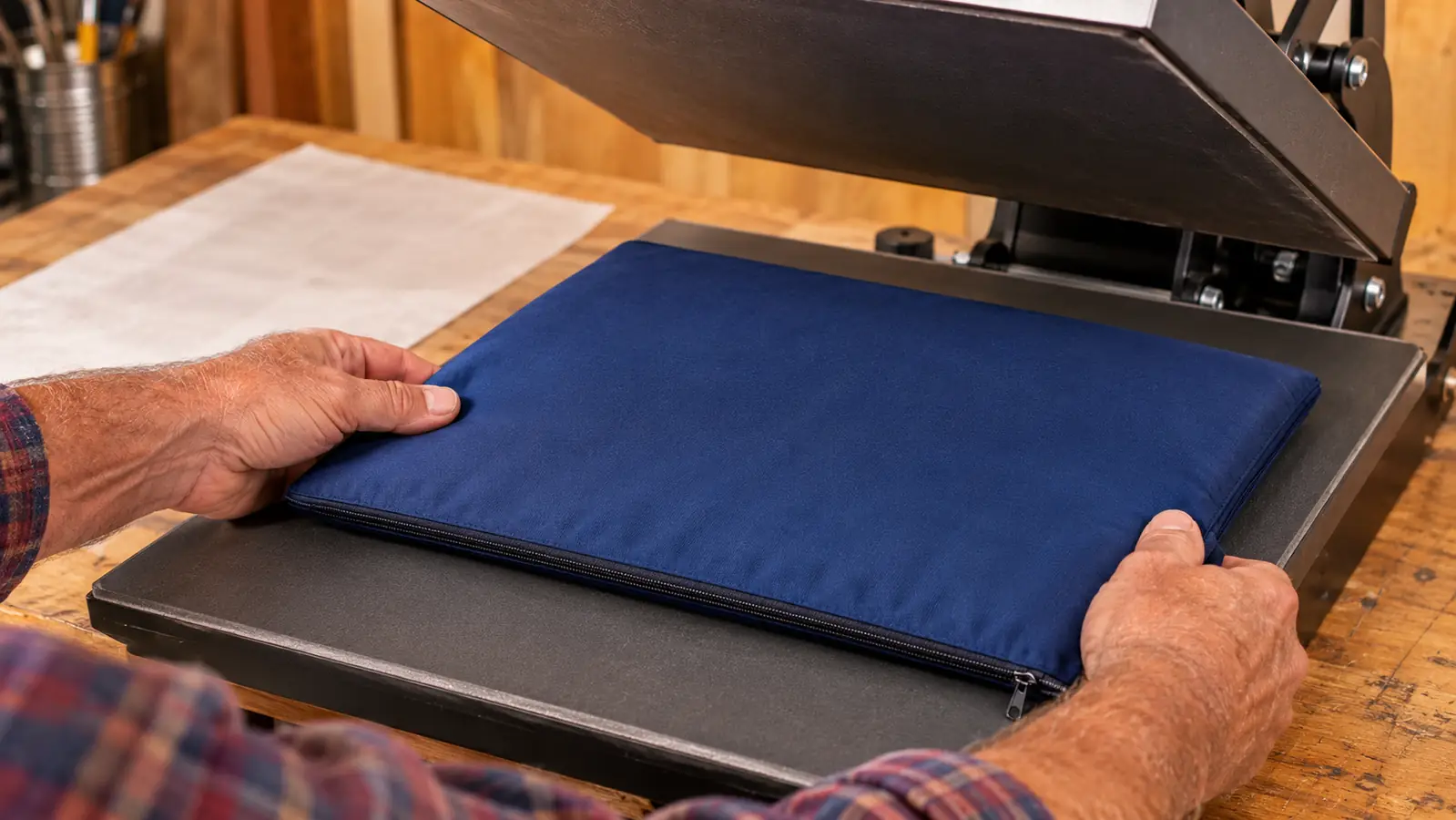
The kit solves the thing that actually ruins blanks, which is uneven pressure. When you press a zippered pouch or a tote with a heavy folded seam, the high point takes the full force of the platen and the fabric around it gets a lighter press. On dark shirts that shows up as a patchy transfer. On bags it shows up as a shiny, pressed-flat zipper with a dull halo around it. The pillow goes underneath and lifts the whole area so the platen meets the panel at one level. My coverage over hardware went from something I had to inspect and often re-press to something I stopped checking. That is not a small change when you are pressing twelve staff shirts on a Tuesday night after work. The project that convinced me was a set of insulated lunch totes for the school office staff, ordered in August before the year started. Every tote had a full-width zipper across the top and a webbing handle on each side. With a towel I would have been lifting and re-seating each one twice. With the 12 x 15 inch pillow under the panel, I pressed the whole stack in one sitting and could not find the one that had given me trouble. That had never happened before.
The second win is repeatability, and this is the part people underestimate. A folded towel is a slightly different object every single time you fold it, and if you are working through a run of twenty items you are also compressing it as you go, so item one and item twenty are pressed under different conditions. The four pillows in the kit are fixed: 5 x 5 inch, 10 x 10 inch, 5 x 15 inch and 12 x 15 inch. I know which one I reach for with a onesie, which one goes under a tote handle, and which one handles a full front panel. The Teflon surface means I am not fighting lint, and the foam is fire resistant, waterproof and reusable. My press does not run anywhere near 600 °F, but it is reassuring that the thing under my blank is rated for work well past what I ask of it.
The third win is quieter and it took me a while to notice: the small sizes. A folded towel is a blunt instrument. It is hard to get a corner of a towel exactly under a pocket without pushing fabric up somewhere else, and sleeves are worse. The 5 x 15 inch piece slides into a sleeve and stays put, so the cuff and the shoulder seam press at the same time. I press a lot of youth jerseys for a local sports team, and the ribbed collar used to be the spot I dreaded. Now it is not a spot I think about.
Where a Folded Towel Wins
The towel wins the argument you have with yourself at the beginning. You own towels. You do not have to order anything, wait for a package, or justify a purchase to anyone, including yourself. When I first started pressing, I used a towel because I was not sure this was going to stick, and I did not want to spend on accessories for something I might drop inside a month. My first two months happened on that same folding table with a household iron and a bath towel folded in half, and I made four shirts that people actually wore. The towel was not the weak link in that setup. The iron was. If you are pressing flat cotton tees with nothing on them, a smooth towel and a careful hand will get you a result you can hand to a friend without apologizing, and the money you save is better spent on a press that closes evenly, which matters more than what sits under the blank.
It also wins on adjustability and coverage. A towel can be one layer, two or three, and that flexibility genuinely helps with something oddly shaped, like a padded koozie or a thick canvas tote where you want a little give rather than a firm surface. The largest piece in the kit is 12 x 15 inches. A bath towel folded once covers more area than that, which matters if you are pressing a full back panel on an adult shirt and want support from edge to edge rather than a pillow floating in the middle. And when a towel finally goes flat, you wash it and grab another one from the closet at no additional cost.
What Is Actually in the Kit and Why Four Sizes Matter
Four pieces: 5 x 5 inch, 10 x 10 inch, 5 x 15 inch and 12 x 15 inch, each one Teflon on the outside with fire resistant foam inside. That reads like a spec sheet until you are standing at the table at nine at night deciding what to put under a toddler tee. The 5 x 5 inch handles small curves and pocket corners. The 5 x 15 inch handles sleeves and tote straps, which are the two things that gave me the most trouble with a towel, because a folded towel is too bulky to sit inside a sleeve without creasing the fabric around it. The 10 x 10 inch covers most onesies and youth sizes. The 12 x 15 inch is the general purpose piece for adult fronts.
The 5 x 15 inch piece is the one I did not expect to use and now reach for constantly. I press a run of long-sleeve tees every October for the church festival booth, and a cuff is a small circumference with a seam running right along it. The strip slides into the sleeve, the cuff sits flat against the platen, and the seam presses without a crease forming on the other side of the arm. With a towel I was folding a hand towel into quarters and stuffing it in, which worked maybe half the time and left a ridge the other half. The whole set weighs 8.48 ounces, so it hangs on a hook on my wire shelf and takes up less room than the towel stack did. The waterproof part matters more than it sounds. Blanks come out of the package slightly damp more often than you would expect, and a cotton towel holds that moisture right against the platen. The Teflon surface wipes clean and does not leave lint on a dark shirt. I did not know I needed to care about lint until I pressed a black tee over a towel and spent ten minutes with a roller picking fibers off a transfer I had just finished.
A folded towel is a different thickness every single time you fold it. That is the whole problem, and no amount of practice fixes it.
Four Fixed Thicknesses Beat One That Changes Every Night
The VCHOMY kit covers sleeves, zippers and full front panels with a Teflon surface rated to 600 °F. Same setup, same pressure, every item in the run.
Amazon Check Today's Price on Amazon →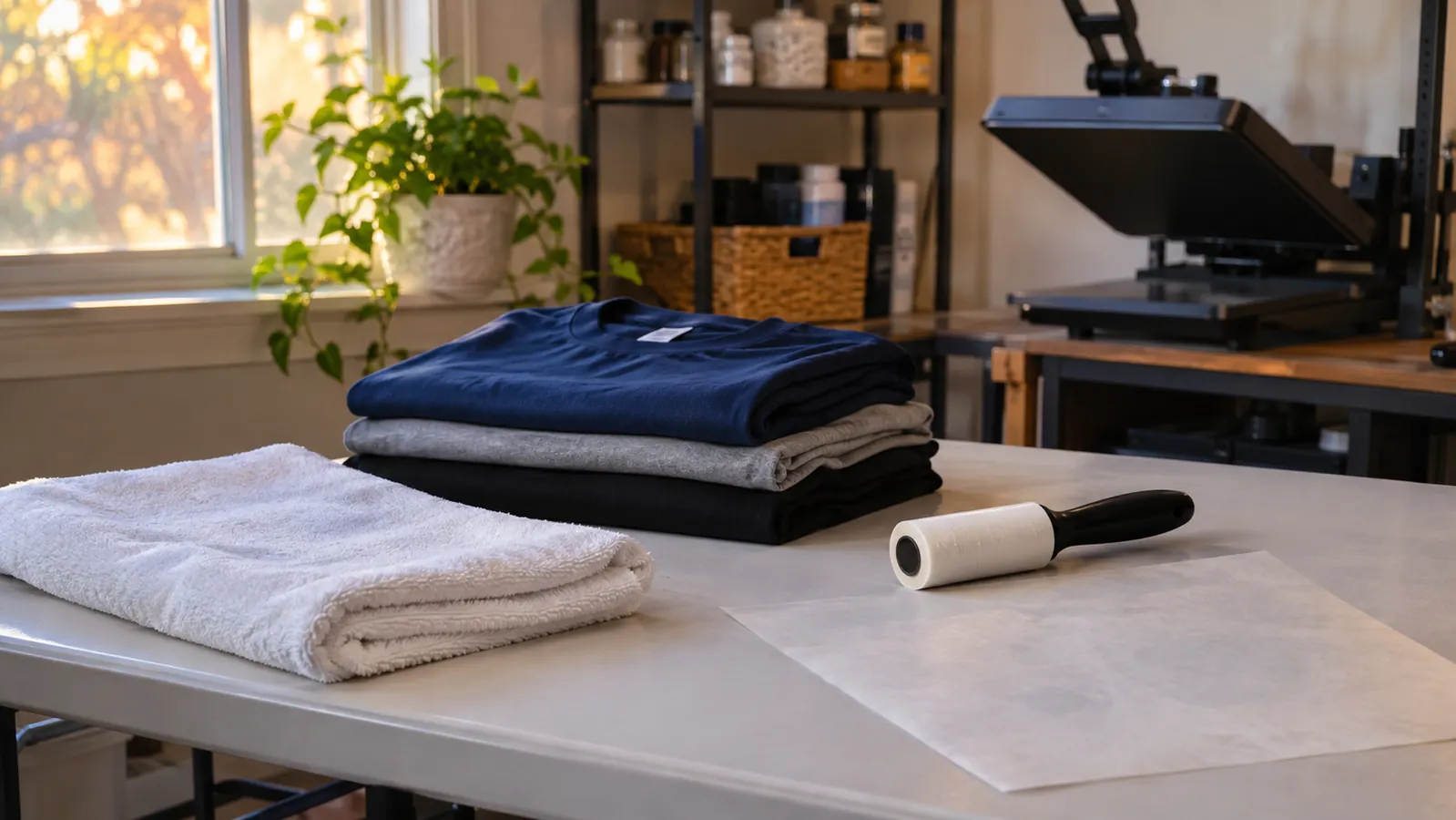
The Two Towel Mistakes That Cost Me Blanks
The first mistake was folding the towel too thick. I went with a bath towel in quarters because more cushion sounded better, and the press could not close properly over it. The transfer looked fine along the edge and lifted in the middle. I re-pressed it, which is always a gamble on a sublimated polyester item, and I slightly scorched the shoulder in the process. Two blanks into the bin for one shirt order, and a lesson about what the press actually needs to seat against.
The second mistake was not swapping the towel between items. Cotton holds heat and moisture, and after six or seven presses it is a warm damp pad sitting underneath your blank. On a run of tote bags for the church festival booth, my transfers started coming out with a faint texture showing through them, the weave of the towel telegraphing into the coating. Nobody at that booth would ever have noticed. I noticed, and I redid four bags. If you are going to stay with a towel, use a smooth one, keep two in rotation so one can cool and dry, and replace it the moment it goes flat. That is the honest version of the towel method, and it is more work than reaching for a pillow. I still keep one towel on the shelf, a smooth white one with the hem cut off, for the odd job where a thick canvas tote wants a little give. It gets washed after every session and it is on its third year. That is what a towel is good for once the pillows are in the drawer: a backup, not the thing you build a run around.
What I Liked
- Even pressure over zippers, seams and plackets
- Four fixed sizes, so the setup is identical every session
- Teflon surface, no lint transfer, wipes clean
- Upper temperature rating of 600 °F
- Waterproof, fire resistant foam, reusable
- The full set weighs 8.48 ounces and stores on a hook
Where It Falls Short
- You have to order it and wait for it to arrive
- Largest piece is 12 x 15 inches, so a full back panel on a big shirt may want more coverage
- Fixed thickness means no fine tuning the way a folded towel allows
- Four pieces is more to keep track of than one towel
- The small sizes are easy to misplace if you do not keep the set together
Who Should Buy Which
Buy the VCHOMY kit if you press anything with hardware on it: zippers, buttons, snaps, thick seams, tote straps, or the ribbed collar of a youth jersey. Buy it if you take repeat orders, even informal ones, because the entire point is that the setup does not drift between item one and item twenty. And buy it if you have already thrown away a blank because a transfer went patchy over a seam. That is the specific problem it fixes, and it fixes it the first time you use it.
Stay with a folded towel if you press a shirt every few weeks, everything you press is flat, and you are still deciding whether you like this enough to keep doing it. Nothing about starting with a towel is shameful. I used one for months and I made things I was proud of. Keep it smooth, keep two so one can dry, and retire it when it goes flat. When you find yourself re-pressing the same seam for the third time in a session, that is your signal, and you will know it when it happens.
When You Are Tired of Re-Pressing the Same Seam
Four sizes, a Teflon surface, a 600 °F rating, and a setup that stops being a variable. See the current listing and the size breakdown on Amazon.
Amazon Check Today's Price on Amazon →