
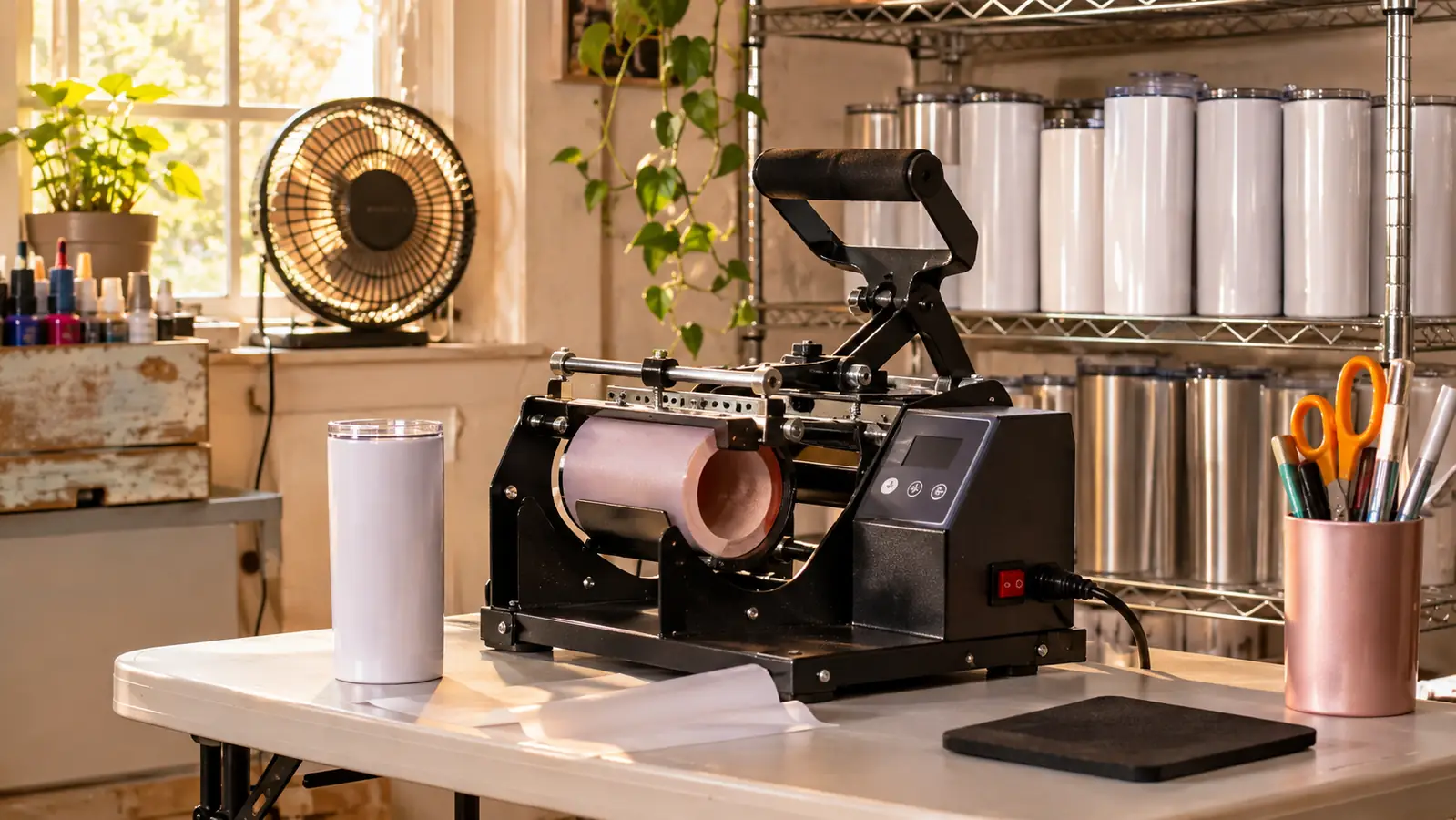
The first twenty tumblers I ever sublimated came out of a kitchen oven wrapped in silicone and butcher paper, and about six of them had a pale band where the wrap had shifted. I kept the failures in a grocery bag under the folding table for a month, mostly to remind myself that a heat source is not the same thing as a heat press. That bag is gone. The HTVRONT Auto Tumbler Heat Press has been sitting on that same folding table for months now, and the failures have gotten a lot less interesting.
I press for a side business, not a living. Weeknights and weekends, in the spare bedroom I turned into a press room: one long folding table, a wire shelf of blanks, a fan in the window because sublimation runs warm and a little gassy. I make shirts, totes and tumblers for school staff, friends, a church festival booth, and a couple of local youth sports teams, plus a small online shop that eats more evenings than I planned on. Four years in, I have ruined enough blanks to have opinions worth passing along.
The Quick Verdict
The press that finally made my fifteenth tumbler on a Tuesday night as good as my first. Tapered blanks and one-at-a-time cycles are the honest limits, and they are real.
Amazon Check Today's Price →The Machine That Made My Tuesday Nights Predictable
It was not the pad or the temperature range that sold me. It was that the cycle runs without me standing over it, which is the whole difference between pressing eight tumblers and pressing twenty.
Amazon Check Today's Price on Amazon →How I've Used It
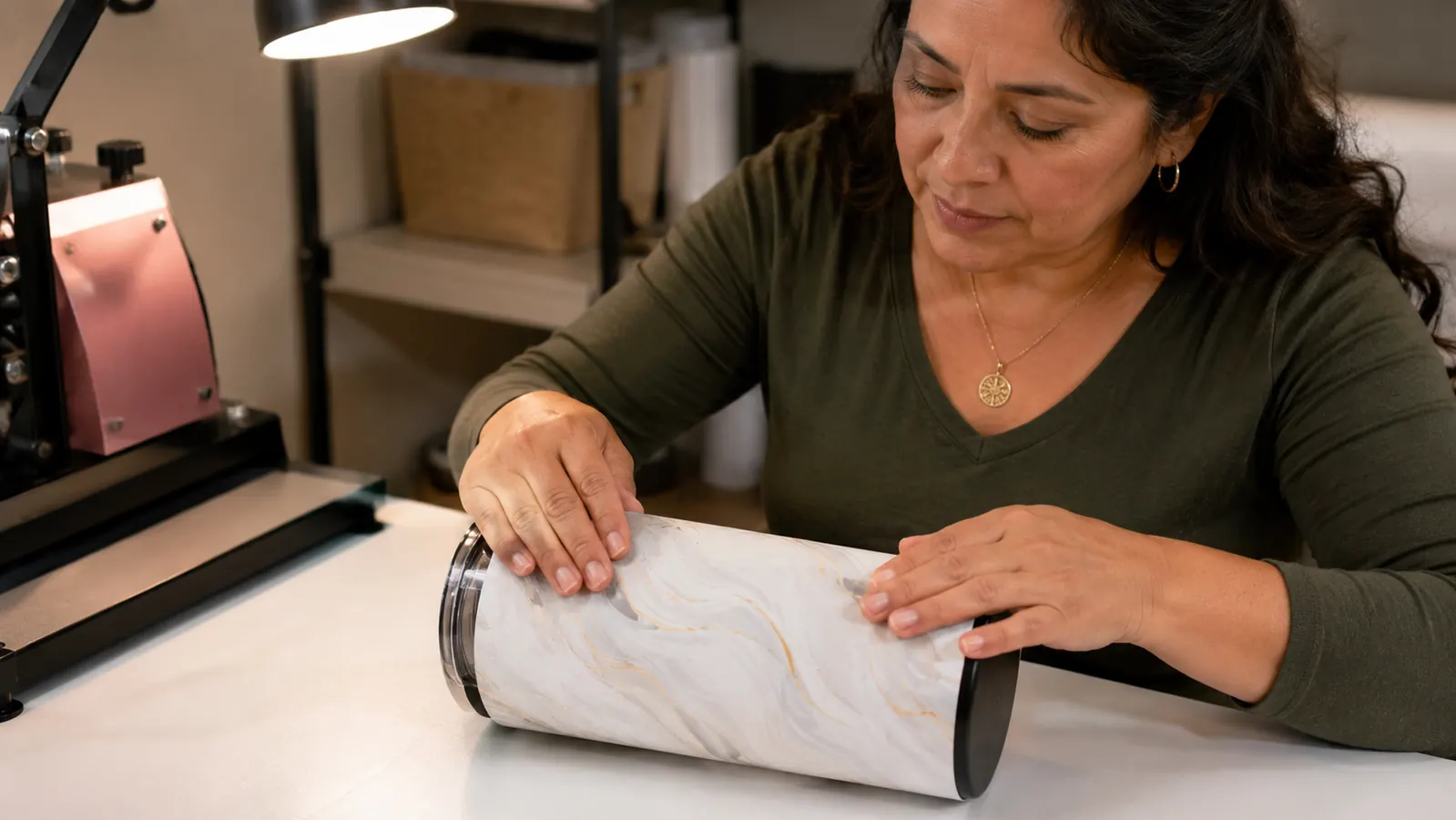
The work itself is unglamorous. Someone wants a tumbler with a team logo on the front and a kid's name on the back. I print the design, tape it to the blank, wrap it tight, load it, close the pad, and wait. Pulling the wrap off while the tumbler is still hot is the part that took me longest to learn, and it is also the part that decides whether the image comes out crisp or washed out. None of that changed when I switched machines. What changed was how much of it I could do without my full attention.
When I was using an oven, every blank needed the same fussy handling, and my attention ran out somewhere around the eighth tumbler. Numbers nine through twenty were consistently worse than the first eight, and I could not figure out why until I admitted it was not the blanks, it was me. With a press, the pad closes on the blank and the cycle runs on its own. I spend that time trimming the next design instead of watching the oven door. Same hands, same designs, better back half of the order.
I have run it on straight tumblers, on a set of glass cans for a friend's fiftieth birthday in April, and on a handful of mugs, since the machine is rated for cup, mug and tumbler work. The glass cans were the surprise. Four of them, wrapped one at a time on a Sunday afternoon while a pot of coffee went cold, and they came out cleaner on my first try than tumblers did, mostly because glass shows a bad wrap immediately and I slowed down accordingly. Mugs are fine as long as you respect the handle. The pad wraps where it wraps, and the handle does not care what you want. I have learned to press mugs on a quiet night when nothing else is running, not stacked behind a team order, because the handle gap makes me wrap slower and check twice.
One thing I did not expect: the machine is quiet enough that I can hear a podcast over it. My oven method meant a kitchen timer going off every few minutes and a house that smelled like hot polyester for an hour afterward. The press keeps the smell to one small room with a fan in the window, and that alone changed how willing I was to take a weeknight order.
What Auto Actually Means in Practice
Auto is worth being precise about, because it does not mean the machine does the work for you, and it certainly does not mean the results are automatic. On a manual tumbler press you clamp, you hold, and you count. On the HTVRONT, the pad closes with the press and the cycle runs. You can step away, trim a design, answer a text from a teacher about a shirt order. That sounds like a small thing until you have stood in front of a manual press for ninety minutes on a Thursday.
The R button is the feature I did not expect to care about. It halts heating and releases the heat pad instantly, so if a wrap has shifted or the paper is crinkling in a way I do not like, I can stop and pull the blank instead of watching it scorch. I have used it perhaps a dozen times over these months. Every one of those was a tumbler that did not go into the failure bag. The first save was a tall blank about three weeks in, where a wrap had started to lift along one seam. I hit R, pulled the tumbler, re-taped the seam, let the blank cool, and ran the cycle again with the same wrap. That tumbler went out the door with a team order. On the old method I would have found that lift by smell.
Temperature runs from 210 up to 390 °F. Most of my sublimation work sits in the upper half of that range, but the low end is not decoration. It is where the blanks that scorch live, and it is where I start when I am testing a blank I have never pressed before. A machine that only goes hot is a machine that does one thing. Having the bottom of the range available means I can learn a new blank instead of guessing at it.
The Fit Question Nobody Warns You About
It takes tumblers from 2.9 to 3.2 inches in diameter, roughly 280 to 850 ml. I want to be blunt about this, because fit is where nearly all of my frustration came from, and it is not really the machine's fault. A tapered tumbler, the kind that narrows toward the base, does not sit in the pad the way a straight-sided one does, and the pad needs contact to move heat. My tapered blanks get a soft band near the bottom no matter how carefully I wrap them. Straight blanks come out even, edge to edge.
If you already own a shelf of a particular blank, measure the diameter before you buy anything. Not the volume, the diameter. A blank a hair over 3.2 inches will not fit, and you will discover that with a design already taped to it and someone waiting on the order. I keep an inexpensive caliper in the drawer now and I check every new blank before it goes on the shelf. The blank that taught me was a case I bought in February off a clearance shelf, thirty-two of them, because the price was good and I did not own a caliper yet. They measured 3.3 inches at the rim. I found out on a Saturday morning with a design already printed and a text thread open, and I ran those eight tumblers through the oven I had sworn off. The rest of the case is still in the cupboard, reserved for practice wraps.
The pad is long enough to reach past the printable area on the taller blanks I use, which is the reason I stopped fighting the oven on tall orders in the first place. Nothing about a taller tumbler breaks the process. You simply have more tumbler below the design, and that is a good problem to have.
Months In: What Holds Up and What Still Annoys
The machine measures 12.9 by 10.9 by 6.3 inches and weighs just under eleven pounds, so it lives on the folding table and moves to the shelf when I need the table back for cutting. The shell is ABS and wipes clean with a damp cloth, which matters if you have ever had adhesive spray settle on a press. The pad surface has held up across a few hundred cycles without glazing or sticking to blanks. That was my main worry going in, because the borrowed press I learned on had a pad that started leaving a shine on tumblers after a few months.
It runs on 120 volts at 600 watts, which in a house wired in the seventies is not a small consideration. It plugs into the same wall I charge my phone on. I have not tripped a breaker once, and I have pressed with the fan and the task lamp running on the same circuit.
The annoyance is throughput. It presses one tumbler per cycle. That is not a defect, that is what a tumbler press is, but it means a ten-tumbler team order is ten cycles and no machine is going to bail you out of a deadline you agreed to on a Wednesday. A ten-piece order takes me a bit over two hours start to finish, and that number includes printing, wrapping and cooling, not just cycles. I know because I timed one in March for a youth soccer order, mostly to see whether I was lying to myself about how long it took. I was. The two hours is not the press's fault either. It is the sixteen minutes of wrap and tape on either side of every cycle, which no machine has ever removed. The oven method can batch more blanks at once if you own a rack and have the nerve for it. You are trading control for volume. I took that trade on purpose and I would take it again tomorrow.
The warranty is one year, and I have not needed it. I did email a sublimation question early on and got back an answer that was actually an answer, not a link to a video, which is more than I can say for a couple of the presses I looked at before this one.
How It Compares to the Oven and the Foil Wrap
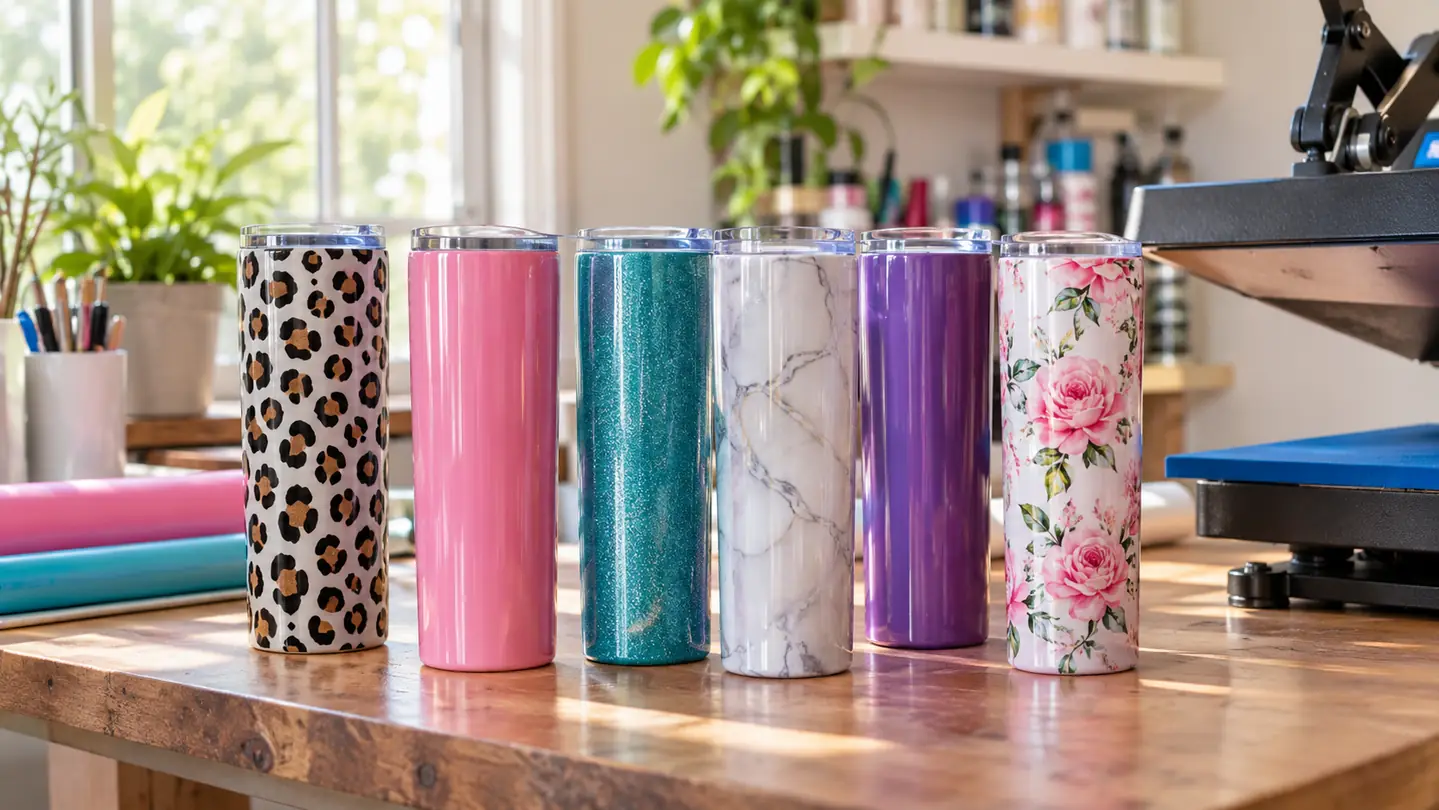
I am not going to pretend the oven stopped working. It still presses a decent tumbler if I wrap carefully, and it handles odd shapes the pad will never see. What it does not do is repeat. The wrap shifts, the paper creases, the blank sits against the rack at a slightly different angle than the last one, and two tumblers from the same batch come out different. The press removes most of those variables, and removing variables is the entire job.
The wrap and foil method is fine for one tumbler for a friend. It is miserable at fifteen. If you are still deciding, the honest question is not which method makes a better single tumbler. It is which method you can do at nine on a Tuesday without starting to hate the work. That question rearranged my whole setup.
What I Liked
- The cycle runs without you standing over it, which keeps the back half of a big order as good as the front half
- The R button halts heating and releases the heat pad instantly, so a shifted wrap becomes a save instead of a ruined blank
- Temperature range of 210 to 390 °F covers both the scorch-prone blanks and the ones that need real heat
- Fits tumblers from 2.9 to 3.2 inches in diameter and roughly 280 to 850 ml
- Just under eleven pounds, so it lives on a folding table and moves when the table is needed
- 600 watts at 120 volts, so it runs on an ordinary household circuit
- One-year warranty, and the support reply I got was a real answer
Where It Falls Short
- Tapered blanks still get a soft band near the base no matter how carefully you wrap
- One tumbler per cycle, so a ten-piece order is ten cycles
- Blanks outside the 2.9 to 3.2 inch diameter window simply will not fit
- The pad does nothing about a bad wrap. That skill is still yours to learn
Sixty tumblers in, I stopped thinking about the press and started thinking about the design. That is the highest compliment I can pay a tool.
Who This Is For
This is for the person who has already made a few tumblers and knows what the work feels like. Someone taking orders, even small ones, from a school staff room or a team or a booth at a church festival. If you are pressing more than five blanks in a sitting with any regularity, the press pays you back in consistency, and consistency is what gets you the second order from the same person.
It is also for the person working in a small space. I do not have a garage shop. I have a spare bedroom with a folding table and a wire shelf, and the footprint fits that without turning the room into a production floor. The weight means I can move it. The wattage means I can plug it in anywhere in the house, which is the sort of detail you only appreciate after you have rearranged a room around an appliance.
Who Should Skip It
Skip it if you press one tumbler a month for yourself. The wrap and foil method costs almost nothing and takes up no space, and no machine is worth owning for a hobby you touch twice a season. Skip it if your blanks are tapered and you are not willing to change blanks, because the press will not fix the shape and you will end up blaming the machine for a fit problem you could have measured in the drawer.
And skip it if you want the machine to make you good. It will not. The first tumbler off a press with a bad wrap is exactly as bad as the first tumbler out of an oven with a bad wrap. What the HTVRONT does is stop punishing you for being tired on the fifteenth one. That is a narrow, specific promise, and I would rather you buy it for that than for anything else I could tell you.
If Your Last Order Got Worse Around Tumbler Nine, Start Here
The fix is not more practice. It is getting your attention out of the cycle so it can go where it actually matters. This is the press that did that on my table, and it has held up across months of real orders.
Amazon Check Today's Price on Amazon →