
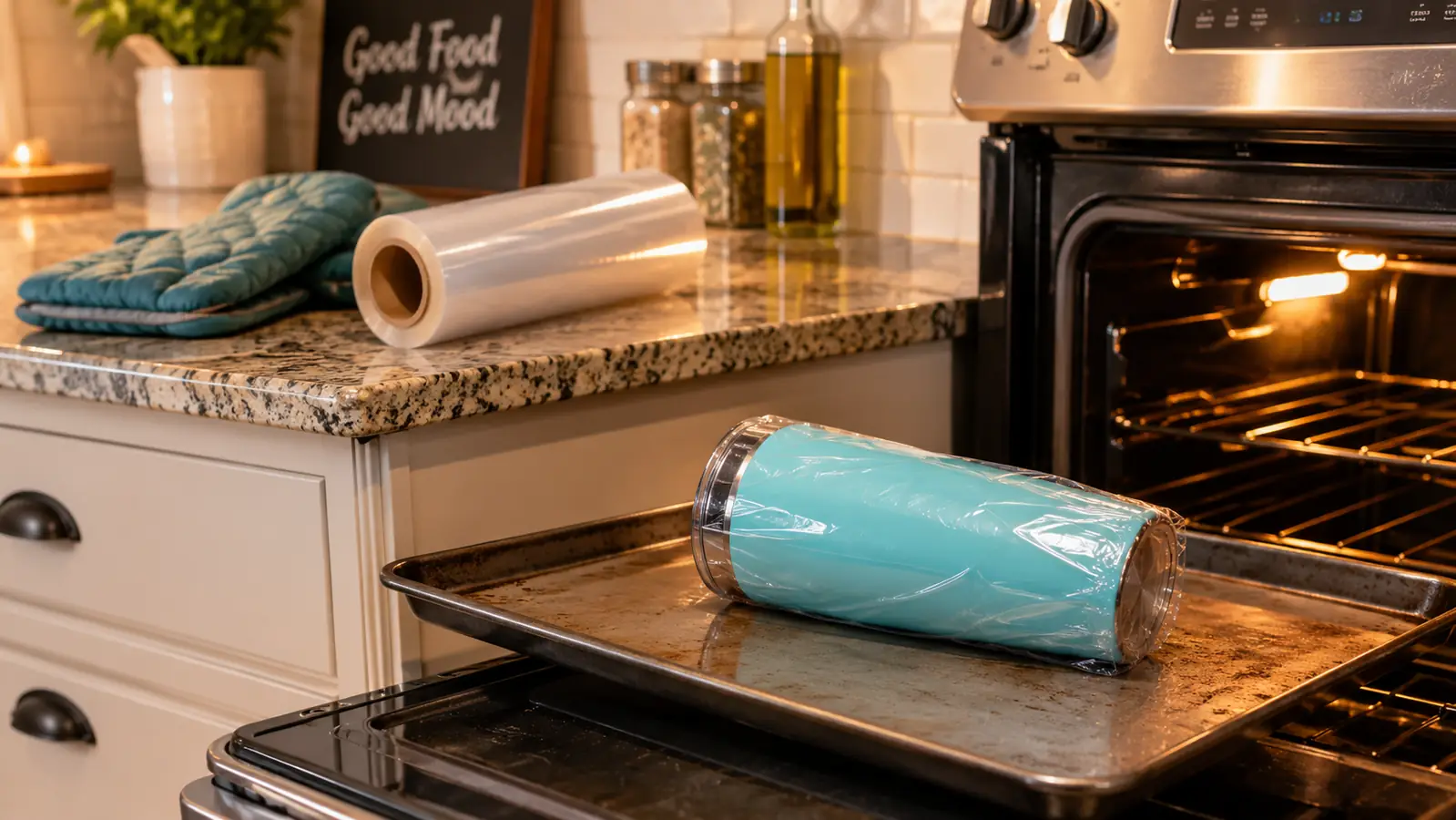
The first tumbler I ever sublimated in my kitchen oven came out with a bright band across the middle where the shrink wrap had pulled tight and a washed out patch where it had not. I stood there in my apron holding a pot holder, looking at a tumbler nobody was going to buy. That was a few years into this hobby, back when I was still practicing on my own blanks before I ever took a real order. Since then I have pressed tumblers for school staff, a church festival booth, and two seasons of youth sports fundraisers out of the spare bedroom in my house, and I have made every mistake the oven and wrap method has to offer. The HTVRONT Auto Tumbler Heat Press is the machine that finally made me stop dreading tumbler orders.
Here is the short answer before I show the work. If you are pressing a few tumblers for friends and you already own a decent oven, the oven and wrap method costs almost nothing to try, and it will teach you what a proper sublimation bond looks like and feels like. If you are taking orders, even small ones, the HTVRONT press removes the two variables that ruined most of my early tumblers: uneven pressure and my own wandering attention.
| HTVRONT Auto Tumbler Heat Press | Oven and Wrap Method | |
|---|---|---|
| Cost to start | One machine to buy, then it handles every tumbler you press. | Very little, if the oven is already in your kitchen. Add wrap, tape and a baking sheet. |
| Pressure on the design | The heat pad closes on the tumbler and stays where it was put for the whole cycle. | Depends on how evenly you wrapped and how hard the wrap pulled. |
| Several at once | One at a time. That is the honest trade. | A full baking sheet at once, if the oven is level and big enough. |
| Repeatability on a reorder | Same temperature, same click, same result, so a reorder matches the first batch. | Every bake is a fresh negotiation with wrap tension and oven hot spots. |
| Wrap and cleanup | No shrink wrap, no tape lines, no trimming a wet print at the sink. | Wrap, tape, trim, and a tumbler that stays sticky until it cools. |
| Safety in a shared kitchen | Sits on a work table away from food, and the R button halts the heating and releases the pad instantly. | A household oven running hot with plastic wrap inside it, in the same box you cook dinner in. |
| Range of blanks | Tumblers from 2.9 to 3.2 inches in diameter and 280ml to 850ml. | Anything that fits on the rack, including handled pieces a press cannot grip. |
| If something goes wrong | One year warranty, and a machine you can actually name when you ask for help. | Nothing to warranty. You replace the blank and try again. |
| Best result on a good day | A clean, even transfer with full saturation. | The same clean, even transfer, from the same paper and the same blank. |
| Learning curve | Temperature, click, done. My second tumbler beat my twentieth oven bake. | Weeks of tuning wrap tension, rotation and rack position before it gets predictable. |
Where the HTVRONT Auto Tumbler Heat Press Wins
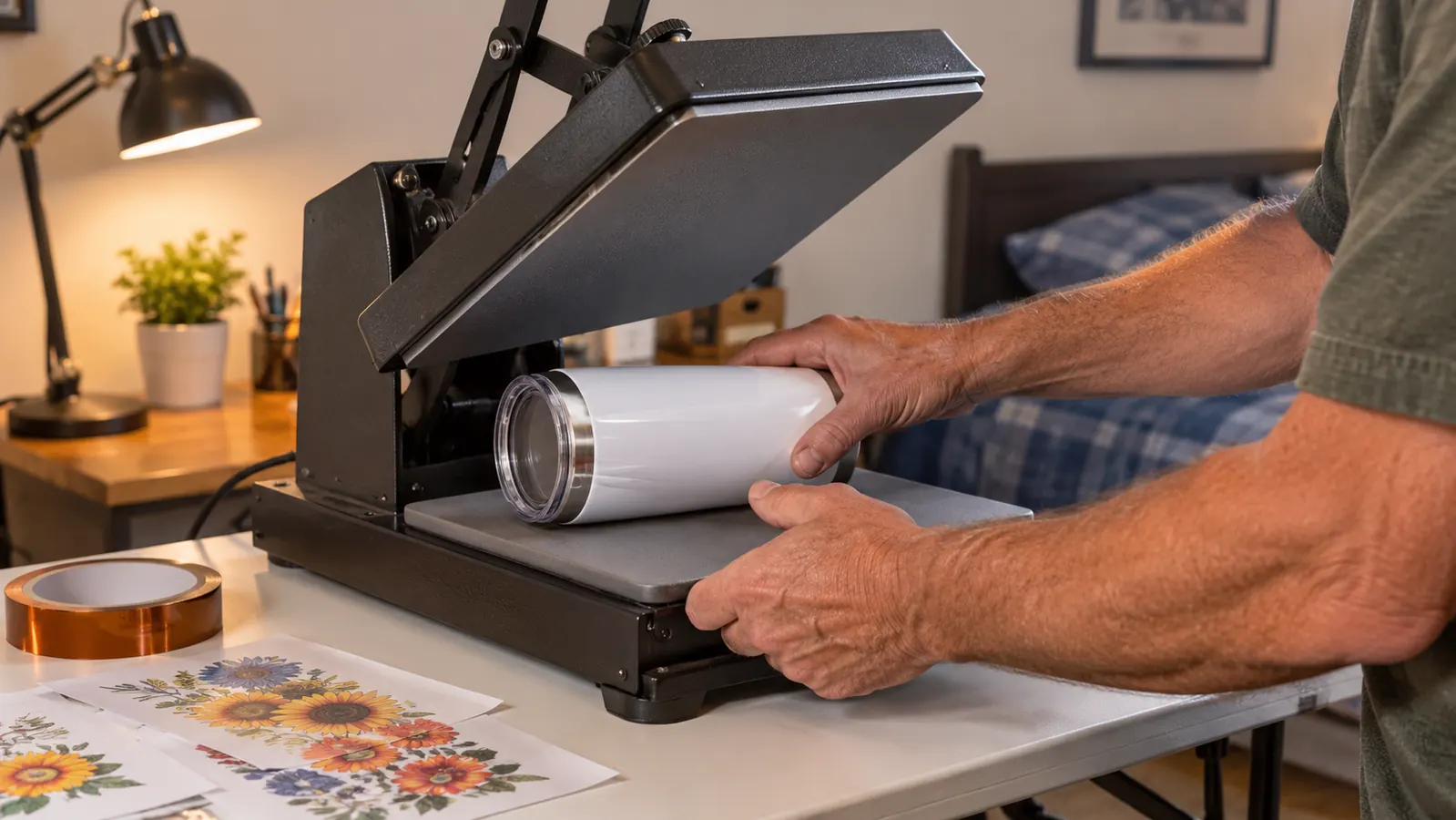
The press wins on the thing that actually decides whether a tumbler sells, and that thing is pressure. With the oven and wrap method, the shrink wrap has to pull the paper tight against the coating all the way around the curve, and it has to do it evenly. When it works, the transfer is beautiful. When it does not, you get a pale stripe, a ghosted edge, or a patch of the design that looks like it was printed on a foggy day. The HTVRONT closes its heat pad on the tumbler and holds it there until the cycle finishes. I load the tumbler, set the temperature, click once, and step away. That is the whole procedure.
The second win is the reorder, and this is the part that surprised me. I expected the press to be faster. Instead it turned out to be more repeatable, which is worth more. Last fall I pressed twenty four tumblers for a youth sports fundraiser, all the same design with four different name sets. Every one of them came out looking like the first one. On the oven I would have been rotating a baking sheet, watching for the hot spot at the back, and pulling each tumbler at a slightly different moment depending on how the wrap looked. I would also have been doing it in the kitchen while somebody wanted to make toast.
Most of my blanks are 20 ounce tumblers, which sit comfortably inside the 2.9 to 3.2 inch diameter range the machine takes, so I have never had to fight the pad to get one seated. Before I settled on those blanks I bought a batch from a supplier whose coating ran thin near the seam, and the HTVRONT faithfully baked that flaw into every single one. That is another thing the press gave me, and it is not the gift it sounds like: I found out inside one cycle instead of finding out after a whole sheet came out of the oven. Two blanks lost on a Tuesday evening, not six lost on a Saturday morning.
Where the Oven and Wrap Method Wins
The oven wins on the cost of starting, and I am not going to pretend otherwise. If your kitchen already has an oven, the method costs you a roll of shrink wrap, some heat tape and a baking sheet. For someone making six tumblers for a teacher appreciation gift, who is not sure this is a business yet, that is the right first step. I would rather see you bake six tumblers and learn what a good transfer looks like than buy a machine you are not ready to use. The method also teaches you to read a transfer by eye, which is a skill that carries over to any machine you own later.
The oven also wins on volume and on odd shapes. A baking sheet can hold several tumblers at once, and a press like the HTVRONT works one at a time, which is the honest trade. A press is also limited by what it can grip. The HTVRONT takes tumblers from 2.9 to 3.2 inches in diameter and 280ml to 850ml, which covers every blank I sell, but it will not take a handled mug or a piece that is too wide for the pad. The oven takes whatever fits on the rack. If your product line keeps drifting toward unusual shapes, the oven stays useful longer than you would think.
Stop Replacing a Press With Shrink Wrap and Hope
The HTVRONT Auto Tumbler Heat Press closes its heat pad on the tumbler and keeps the pressure on until the cycle finishes. One click, no rotating a baking sheet, no wrap to trim, and the second batch looks like the first.
Amazon Check Today's Price on Amazon →How I Set It Up in a Spare Bedroom
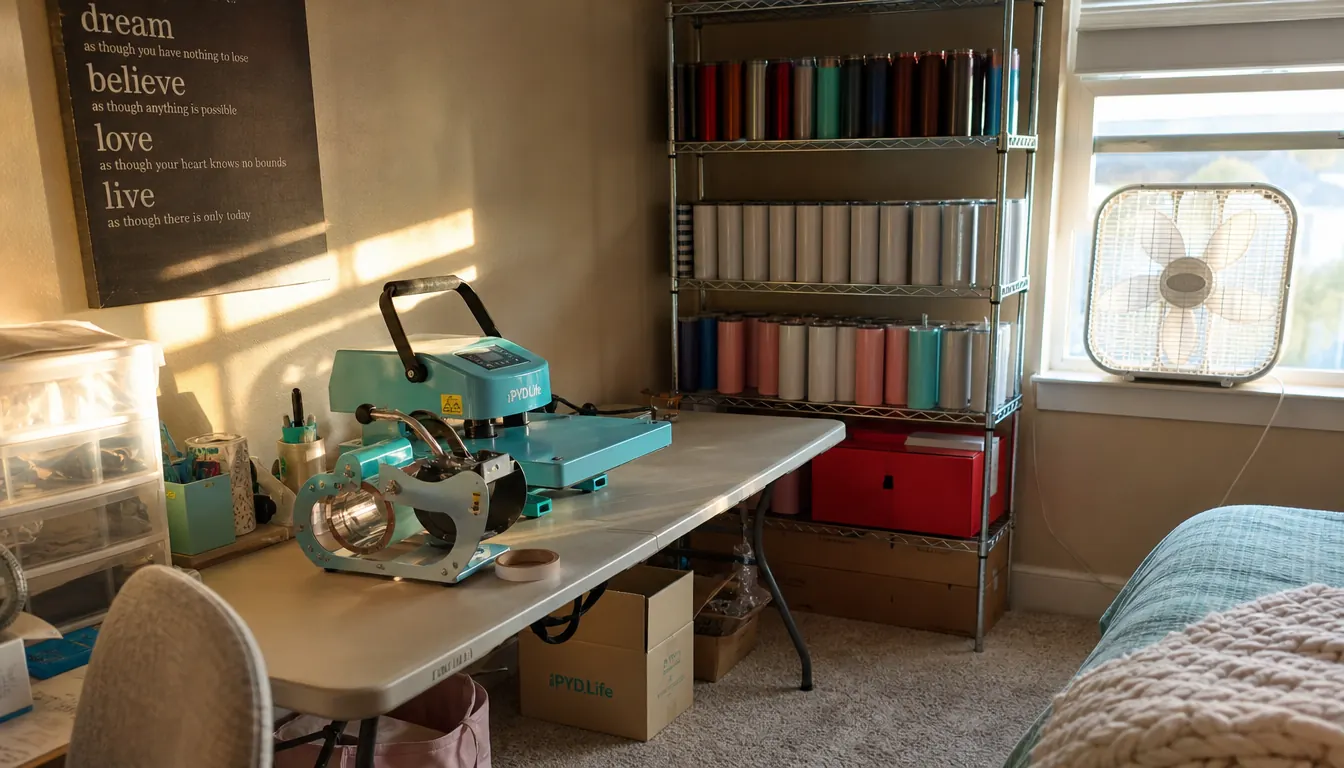
The HTVRONT measures 12.9 by 10.9 by 6.3 inches and weighs 4.92 kg, which is why it lives on my folding table and not in a corner of a garage I do not have. When the table has to become a shipping station, I lift it to the wire shelf and it takes up less room than a stack of storage bins. It runs on 120 volts at 600 watts, so it shares the bedroom circuit with my laptop and my label printer without me worrying about the breaker. The shell is ABS, which I care about mostly because it wipes clean when I get transfer paper dust on it.
The first afternoon it was on the table, I measured from the back of the machine to the wall and gave it about four inches of breathing room, then ran a few empty cycles to see how warm that corner of the room got before I trusted a blank near it. The table is three feet deep and six feet long, which sounds generous until you add a heat mat, a tray of blanks waiting their turn, and a dish of finished ones cooling. I keep the press toward the right end so I can slide a tumbler sideways onto the cooling tray without lifting it over anything.
The feature I use more than I expected is the R button, which halts the heating and releases the heat pad instantly. On a hot pad with a tumbler inside, that is the difference between a bad moment and a ruined blank. I have burned myself on a kitchen oven more than once, and I once had a pad that would not let go when I wanted it to. In a spare bedroom with a fan in the window, a machine that lets go on command is not a small thing.
What It Does Not Do
It does not press more than one tumbler at a time, and it does not fix bad materials. If your blank has a thin coating or your paper is wrong for the job, the press will happily bake that mistake onto the surface for you. I keep a note taped to the shelf listing the blanks I trust and the settings I use on each one, because the machine holds a temperature but it does not know what you put in it.
It also does not remove the need to practice. You still have to learn how much pressure a design needs, how long a full wrap takes at a given temperature, and how a tumbler should look when it comes out. The difference is that once you learn those things on a press, they stay learned. On the oven I was relearning them every single batch, because the wrap never behaved the same way twice.
And it does not take every shape. Last spring a woman from the church festival asked whether I could do twelve handled camp mugs to match the tumblers I had already made her. The pad takes tumblers from 2.9 to 3.2 inches in diameter and 280ml to 850ml, and a handled piece will not seat in it no matter how carefully you feed it in. I said no and I meant it. Knowing the edge of the machine before you accept an order is worth more than the order.
Twenty four tumblers for one fundraiser, and the only thing that changed between the first and the last was the name on the back.
The Two Mistakes That Cost Me the Most Tumblers
The first was wrap tension. You want the shrink wrap snug enough to press the paper down and not so tight that it shifts the design or pulls the seam. I used to wrap by feel, in a hurry, and the difference between snug and too tight is about the width of a fingernail. The tumblers that failed were always the ones I wrapped fastest. When I moved to a press, that variable disappeared, and with it went most of my rejects.
The second was oven placement. My oven runs hot at the back right corner. I know that now. I put an oven thermometer on the middle rack and left it there for a week, and the gauge read about twenty five degrees above what the dial said. That is my oven and probably not yours, but every household oven has a personality like this, and the shrink wrap follows it. In the beginning I would put four tumblers on a sheet, shut the door, and come back to find the one in that corner scorched and the one at the front underdone. Turning the sheet halfway through helped. It did not fix it. This is not a flaw in the method so much as a fact about household ovens, which are built to cook food evenly enough, not to hold a precise temperature for craft work.
Both mistakes have the same shape: they depend on me noticing something and reacting in time. That is the real argument for the HTVRONT, and it has nothing to do with speed. A press does not notice anything. It sits there and holds pressure at a set temperature until it is done, which means a distracted person and a careful person get the same tumbler out of it. For someone pressing orders at nine at night after a full day in a school office, that matters more than any feature list.
Who Should Buy Which
Buy the HTVRONT if you are taking tumbler orders, if you have already ruined a few in the oven and cannot tell what went wrong, or if your work space is a room in your house that you share with the rest of your life. It also makes sense if you know your own weakness, and mine is attention. I get distracted. A machine that holds the pressure for me is worth more than a method that saves me money and then asks me to stand there and watch it. The one year warranty helps too, and so does a temperature range that runs from 210 to 390 °F without needing a second machine.
Stay with the oven and wrap method if you are still in the trial stage, if you press a dozen pieces a year, or if your product line keeps drifting toward shapes a press cannot hold. There is no shame in it. Some of the best tumblers I have made came out of that oven, and the method taught me to read a transfer properly. What it did not teach me was how to do the same thing twenty four times in a row on a Thursday night when I had promised a team mom a full set by Friday.
Press the Next Order Instead of Baking It
The HTVRONT handles tumblers from 2.9 to 3.2 inches in diameter and 280ml to 850ml, holds its own pressure through the cycle, and comes with a one year warranty. If the orders keep coming, this is the machine that stops every one of them being a coin flip.
Amazon See It on Amazon →