
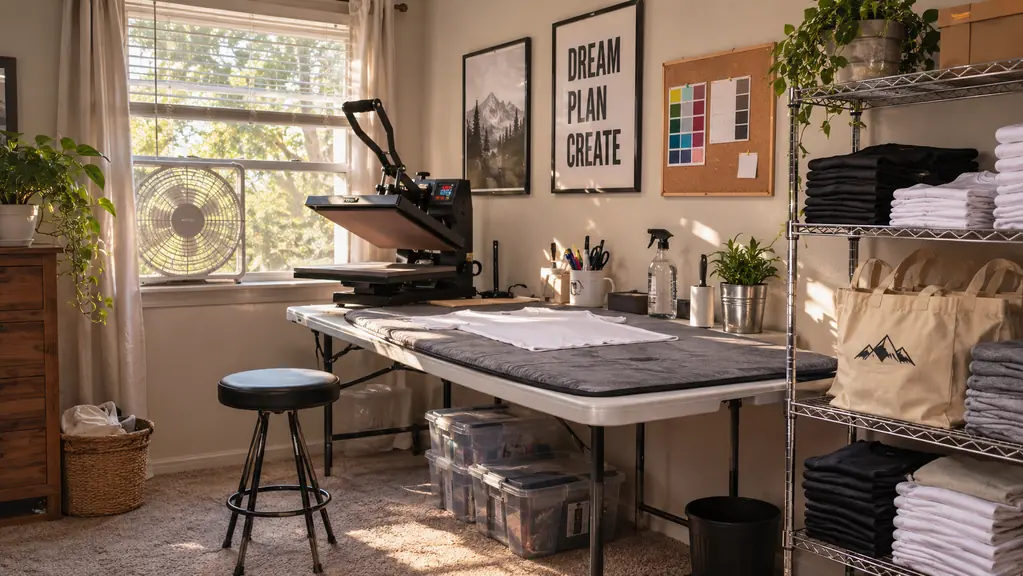
I have owned the Cricut EasyPress Mini long enough to have a stack of ruined blanks behind me, and I want to start there rather than with the parts that work. My press room is the spare bedroom: one long folding table, a wire shelf of blank shirts and totes, and a fan wedged in the window because a heat press in a small room gets warm fast. I press for school staff, a church festival booth, two youth sports teams, and a small shop that trickles in orders on weeknights. Four years of that has taught me which tools earn their table space and which ones just look like they will.
The honest version of this review is that the Cricut EasyPress Mini is a good tool with a narrow job, and most of the disappointment people feel about it comes from buying it for the wrong job. It is not a small version of a full-size press. It is a hand-held tool for curves, seams, brims and small placements, and it is genuinely excellent at those. The trouble starts the first time you try to press a full shirt front with it, because you will be there all evening. Cricut sells plenty of things that do that job. This is not one of them.
The Quick Verdict
A precise hand-held press for hat brims, seams and small placements. It is not a stand-in for a flat plate with a clamp, and the size that makes it useful is the same size that limits it.
Amazon Check Today's Price →Worth it for curves and small logos. Not for a full shirt front.
If your work is hat brims, sleeves and tote panels, this is the tool that reaches them. Check today's price and the return window before you commit, because one project will tell you whether it fits your work.
Amazon Check Today's Price on Amazon →What This Press Actually Is
The listing calls it mini but mighty, which is the sort of thing you skim past. The measurements are the useful part. It comes in at 2.52 inches long, 3.94 inches wide and 4.61 inches tall, and it weighs 13.44 ounces. That is small enough to sit on the corner of a folding table without crowding anything, and light enough that holding it through a full press cycle is not a workout. Small and light is the whole point. Everything good and everything frustrating about the tool comes from those two facts.
The plate is ceramic, the upper temperature rating is 204 °C, and it has a precision tip that narrows at the nose so you can get into places a flat plate cannot reach. There is an insulated safety base it sits on when you set it down, and an auto-off feature so it does not stay hot if you get pulled away. It is corded, so you are tethered to the outlet near the window, which matters more than you would think when you are arranging a table. Those are the real specs. Nothing in there does the work for you.
How I Actually Use It
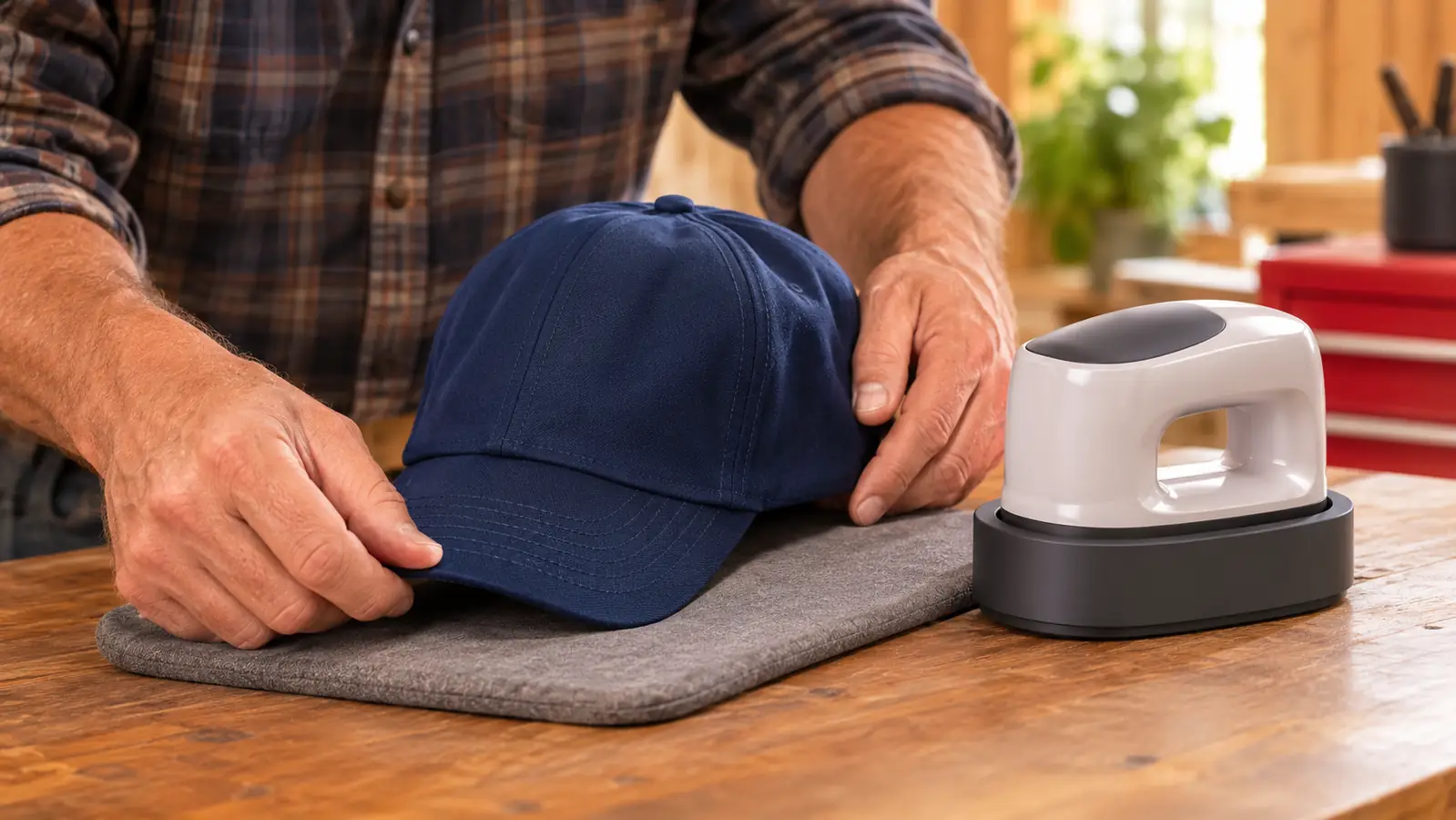
Hat brims are the reason I keep it. A cap has a curved bill and a dome, and a flat plate fights both. The Mini's nose gets under the curve and around it, and you work in short overlapping passes around the brim rather than trying to press the whole thing at once. It takes a few minutes per hat. It works. I have done enough of them now that I can do a batch while half listening to the radio, which is the sign of a tool that has settled into the workflow instead of fighting it. The first batch I did was eleven caps for a youth football team, on a Tuesday in October, and I got through four of them before I figured out the order of operations: press the dome first, then work around the brim in overlapping passes that each start where the last one ended. Once I stopped hopping around the cap, the edges lined up and the whole batch took me a little over an hour, including the time I spent peeling and re-laying two logos that had crept.
The second use is small placements on shirts. A name on a sleeve, a small logo above a pocket, a left-chest design on a staff shirt. If the design is genuinely small, the Mini handles it in one or two passes, and the precision tip means you are not fighting the edges of a big plate over a seam. The moment the design grows past a couple of hand widths, the pass count starts climbing and so does the risk that you shift something halfway through and do not notice until you peel.
The third use is totes and anything with a strap or a seam in the way. The handle of a canvas tote is a ridge you have to work around, and a flat plate either misses the area next to it or presses the ridge into the design. The Mini goes around it. The listing also names mugs as a recommended use. I tried. Holding a curved ceramic surface steady at temperature, with even pressure, for the full press time, is a two-handed job that I never got clean results from. That is a mismatch between the tool and the job, not a flaw in the tool.
What the Spec Sheet Does Not Tell You
The 204 °C ceiling looks generous until you use the Cricut Heat Guide and find that some blanks and materials want the top of that range. When a guide sends you to the ceiling, you have no headroom left. A full-size press has room above the recommendation, so a thick or cold blank is an inconvenience rather than a problem. Here it is a wall. Knowing that in advance means you pre-press the blank properly and you do not try to compensate for a cold shirt by cranking the temperature, which is exactly what I did for the first month.
Nobody warns you that you are the clamp. A full-size press closes and holds its own pressure for the entire cycle. The Mini does not. Every second of the press time, the pressure is your hand and your shoulder, and it needs to be even. Lean too hard and you can press an impression into the material or leave a shiny patch. Lean too light and the adhesive never fully activates, which produces a design that looks perfect on the table and lifts at the corner after the second wash. Learning what even pressure feels like is the actual skill of this tool. I learned it on scrap. I cut six two-inch squares of the same vinyl, pressed each one on a spare shirt at a different pressure, and labeled them with masking tape. The one that looked best on the table was over-pressed and had a faint shine along the edge. The one that looked slightly dull held through twenty washes. I still keep that shirt folded on the shelf as a reference, and I still check a new material that way before I touch a real order.
The auto-off and the safety base are the two features I would not buy without now. The base means I can set the tool down mid-project on the folding table without clearing a landing spot first, which sounds small until you have done it a hundred times. The auto-off matters because I get phone calls from the school office at bad moments. Twice I have come back to the table having forgotten it entirely, and both times it had shut itself down instead of sitting there hot. That is the kind of feature you only notice the day it saves you.
Every design I have had peel on the second wash failed for the same reason, and it was never the press. It was a skipped pre-press on a cold blank.
The Parts That Genuinely Annoy Me
The size cuts both ways and I will not pretend otherwise. A small plate means more passes. A design that a full-size press covers in one go takes four or five overlapping passes here, and every overlap is a place where the design can shift or an edge can get double-pressed and show a line. On a single hat that is fine. On twelve team shirts in one evening, the pass count is the difference between finishing before ten and finishing after midnight. I plan around it now, but I feel it every single time. The month that taught me was November, when a church festival order landed four days before the booth and I had sixteen tote panels to do. I did four a night after work instead of trying to do them all on Saturday, and even then the last panel of each night was sloppier than the first. That is not a defect I can fix with technique. It is the tool telling me its capacity, and the honest answer is to plan the calendar around it rather than argue with it.
There is no clamp and no hands-free option, so both hands are committed the whole time. That is fine for me. It is not fine for everyone. If you have grip or wrist problems, or you are pressing for longer stretches than twenty minutes, a 13.44-ounce tool that nothing holds but you will make itself known by the end of the batch. I would rather say that plainly than have someone order it and find out on their third hat, when returning it has already become a chore.
The cord is a smaller annoyance but a real one. It comes off the back, so which side of the table you stand on is decided for you by where the outlet is. I ended up turning my whole setup around to keep the cord from dragging across vinyl I had just laid down. It cost me an afternoon of rearranging and a longer extension cord. Not a reason to avoid the tool. Just the kind of thing that is invisible in a listing photo and obvious on day one.
What I Liked
- The precision tip reaches hat brims, sleeve seams and the area beside a tote strap that a flat plate cannot
- 13.44 ounces and under five inches tall, so it stores on a wire shelf instead of owning the table
- Insulated safety base means you can set it down mid-project without building a landing pad first
- Auto-off has saved me twice when the phone rang in the middle of a press
- The Cricut Heat Guide gives a starting time and temperature per material instead of guesswork
Where It Falls Short
- You are the clamp, so even pressure for the whole cycle is on your hand and shoulder
- The 204 °C ceiling leaves no headroom for blanks that want the top of the range
- Large designs need four or five overlapping passes, which is where shifts and double-press lines happen
- Mug pressing is listed as a use and stayed blotchy every time I tried it
- Nothing holds it down, which rules it out for anyone with grip or wrist trouble
Three Mistakes I Made So You Do Not Have To
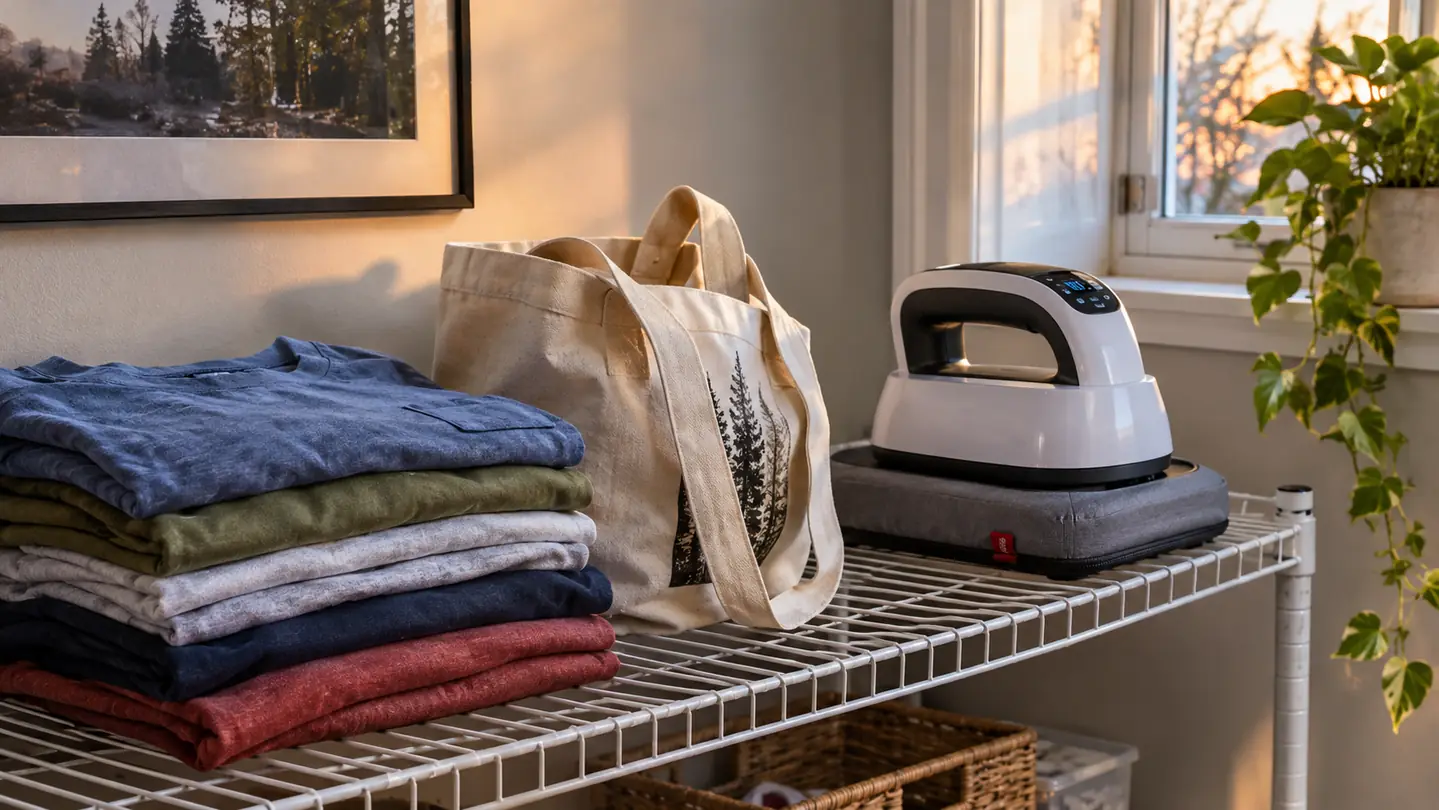
The first was skipping the pre-press. A cold blank holds moisture, and moisture is what makes a design lift at the edges months later, usually after the person has washed it four times and told everyone how much they like it. The shirt that taught me was a staff tee for the school office, a cotton blend I had pressed a dozen times without trouble, done on a damp January morning when the bedroom was cold and the shirt had spent the night in my car. It looked perfect. It lifted at the shoulder seam after the third wash, and the person who bought it is someone I see at work every day, which is its own kind of accountability. Two quick passes with the Mini over the shirt before the design ever goes down fixed a peeling problem I had spent a year blaming on cheap material. The tool did not change. My process did. It is the highest-value habit I picked up in four years of pressing.
The second was guessing at peel temperature. Some materials want to come off hot, some want to cool completely before the carrier lifts, and peeling the wrong one at the wrong moment stretches the carrier and distorts a design that pressed perfectly. Read the Heat Guide entry for the specific material rather than the general one, then actually wait the full time. I have ruined more pieces by being early than by being too hot, and being early feels productive the entire time you are doing it.
The third was assuming a bigger plate would have saved the project. It would not have. The pieces that failed on this tool were pieces where the surface curved away from a flat plate anyway, which is why I bought the Mini in the first place. What would have saved them was knowing the material, pre-pressing the blank, and giving the whole thing more time than I thought it needed. None of those are things you can buy. All of them are cheaper than a second press.
The tool is not the bottleneck. The process is.
If your work is curved, small or awkward, this press removes the part of the problem that hardware can actually fix. Check today's price before you decide.
Amazon Check Today's Price on Amazon →Who This Is For
This is the right tool if your work is small, curved or detailed, and you are pressing at a table in a spare room rather than running a shop floor. Hat orders for a youth team. Names on sleeves for school staff. A tote panel for a church festival booth, where the design sits in the middle of one face and nowhere near an edge. If you are doing a handful of pieces at a time and you want something that reaches the awkward spots, this covers most of it and takes up almost no space when you are done.
It is also a sensible first press for someone who has been fighting a household iron. An iron has a dial that lies and a plate with steam holes in it, and it gives you no repeatable starting point. The Cricut Heat Guide plus a plate that holds a steady temperature is a real step up, and the small size means you learn pressure and timing on pieces that are cheap to redo rather than on a full shirt front you only get one shot at.
Who Should Skip It
Skip it if your orders are full fronts, full backs, or anything bigger than a couple of hand widths. Skip it if you press a dozen or more of the same thing in a sitting, because the pass count turns into an evening. Skip it if you have grip or wrist problems, since nothing clamps and nothing holds the tool but you. And skip it if you want one tool that covers hats, mugs and full shirts, because that tool does not exist and this one does not pretend to be it.
The group I would say it to most plainly is the one buying this to avoid buying a bigger press. This is a companion tool. Almost everyone I know who uses one regularly also owns something with a flat plate and a clamp, and the two do different jobs on the same table. Buying the Mini first is fine if your work is small and curved. Buying it as a substitute for a flat press is how you end up with a shelf of half-finished ideas and a bad opinion of a decent tool.
Buy it for the curves. Keep your flat press for the rest.
The Mini is the best answer I have found for hat brims, seams and small placements, and a poor answer for everything else. If that matches the work in front of you, check today's price.
Amazon Check Today's Price on Amazon →