
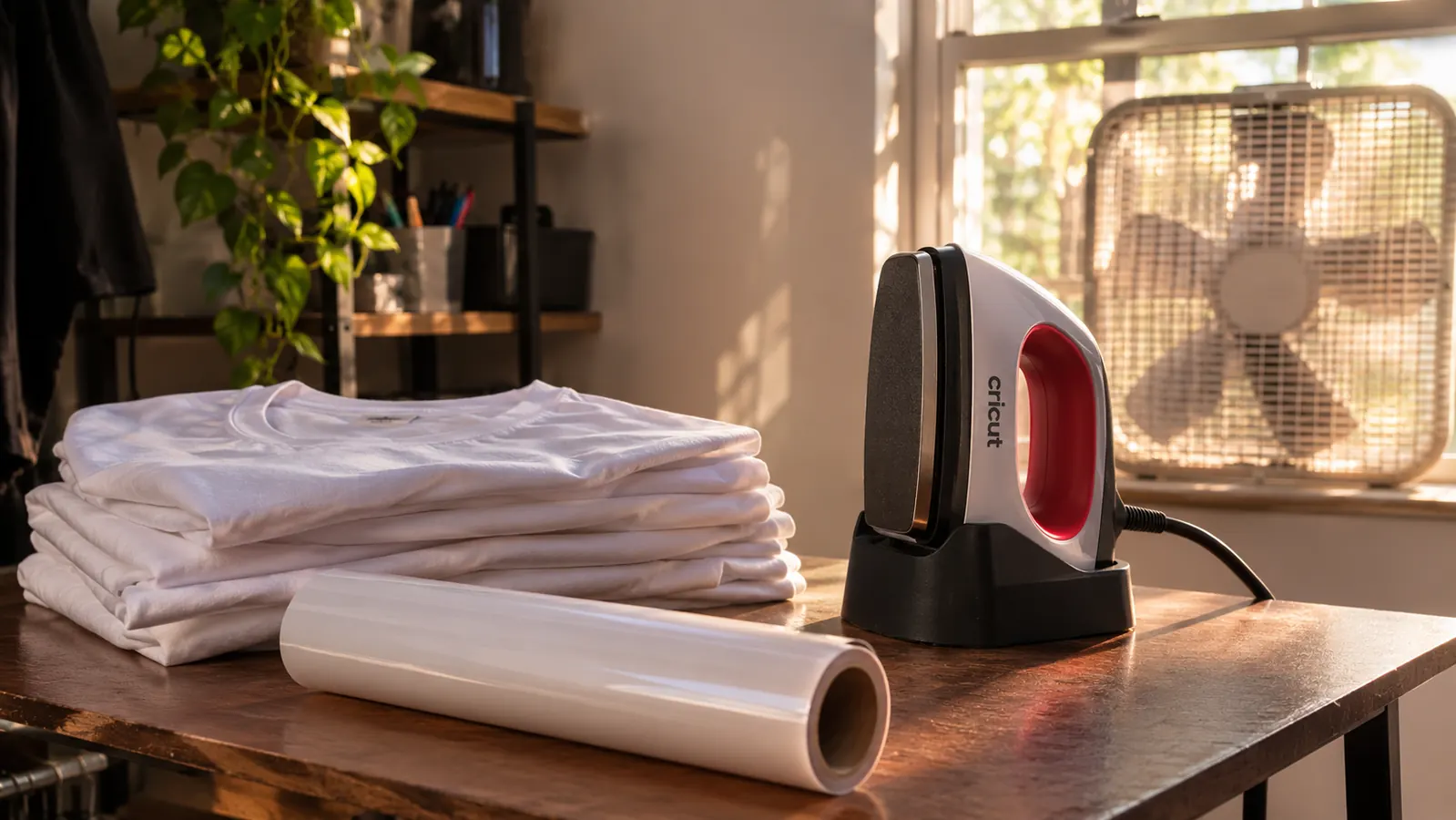
Two weeks after I pressed my first shirt with a regular iron, the vinyl started lifting at the corners. I had followed the tutorial, counted to twenty, used a pillowcase over the top like the video said, and it still peeled. What I did not understand yet is that a household iron does not hold a temperature. It heats, it clicks off, it comes back up. The adhesive under heat-transfer vinyl needs steady heat for a set number of seconds, and a plate that swings up and down never quite delivers that. Four years and a lot of ruined blanks later, that is still the shortest explanation I can give.
So here is the comparison I wish someone had handed me then: a Cricut EasyPress Mini against the iron that was already sitting in my laundry room. One is a small ceramic heat press built for hats, mugs and tight spots. The other is a general-purpose appliance that happens to get very hot. They are not the same tool doing the same job, and once you see where each one actually works, the decision gets a lot easier. Cricut sells the Mini as compact and precise. After four years of using one on school staff shirts, church festival totes and youth sports jerseys, I think that description holds up. The iron still has a job in my house. It is just not the job I thought it was.
| Cricut EasyPress Mini | Regular Iron | |
|---|---|---|
| Holding a temperature | You set the temperature the Cricut Heat Guide lists and it stays there | Climbs, cuts out and climbs again as the thermostat cycles |
| Coverage on flat fabric | Small plate, built for names, cuffs and small designs | Wide soleplate covers a whole back panel in one or two passes |
| Curves and three-dimensional blanks | Precision tip works into hat seams and around a mug wall | Cannot follow a curve or press into a cap at all |
| Shutting itself off | Auto-off is built in | Depends on the model, and plenty of older irons have none |
| Setting it down mid-project | Comes with an insulated safety base | Needs a trivet or a folded towel you have to remember to grab |
| Storage | 13.44 ounces, small enough to live in a drawer | Bulky, and you wait for it to cool before it goes away |
| What it will press | T-shirts, hats and mugs, per the manufacturer's recommended uses | Flat fabric only, unless you get creative and lucky |
| What it adds to your setup | One more tool on the shelf | Nothing, you likely already own one |
| The rest of your house | Does only what it was made for | Also presses work shirts, curtain hems and sewing seams |
| Warranty | One year limited | Varies by brand and age, often unknown by the time you start |
Where the Cricut EasyPress Mini Wins
The first thing it wins is repeatability. When I press six shirts for the school office, I want shirt one and shirt six to look the same, because the woman wearing shirt six will stand next to the woman wearing shirt one all afternoon. I set the temperature the Cricut Heat Guide lists for that blank and that material, wait for it to come up, and press. Then the next one. The number does not drift on me. A regular iron cannot promise that. It climbs, it cuts out, it climbs again, and you are guessing which part of the cycle you caught when you leaned on it.
The second win is the shape of the plate. The Mini has a precision tip, and that tip is the reason I stopped dreading hats. A cap has seams, a curved crown and a panel you cannot lay flat no matter how you stuff it. The tip gets into that seam and lets you work around the curve a section at a time instead of fighting the whole thing at once. Same story with the inside seams of a tote bag and the narrow gap between a sleeve hem and the body of a shirt. A full-size soleplate is simply too wide and too flat to get in there, so you end up folding the fabric in ways that put a crease where you did not want one.
The third win is the boring one, and it matters more than people expect. The Mini is 13.44 ounces. It has an insulated safety base you set it down on, and it shuts itself off when you forget about it, which you will, because the phone rings or the dog next door starts up and suddenly it has been twenty minutes and you are in the kitchen. An iron has to be stood upright, and if you knock it, it falls. I have a cutting mat with a scorched corner that proves the point, and I kept it for a year to remind myself.
Where a Regular Iron Wins
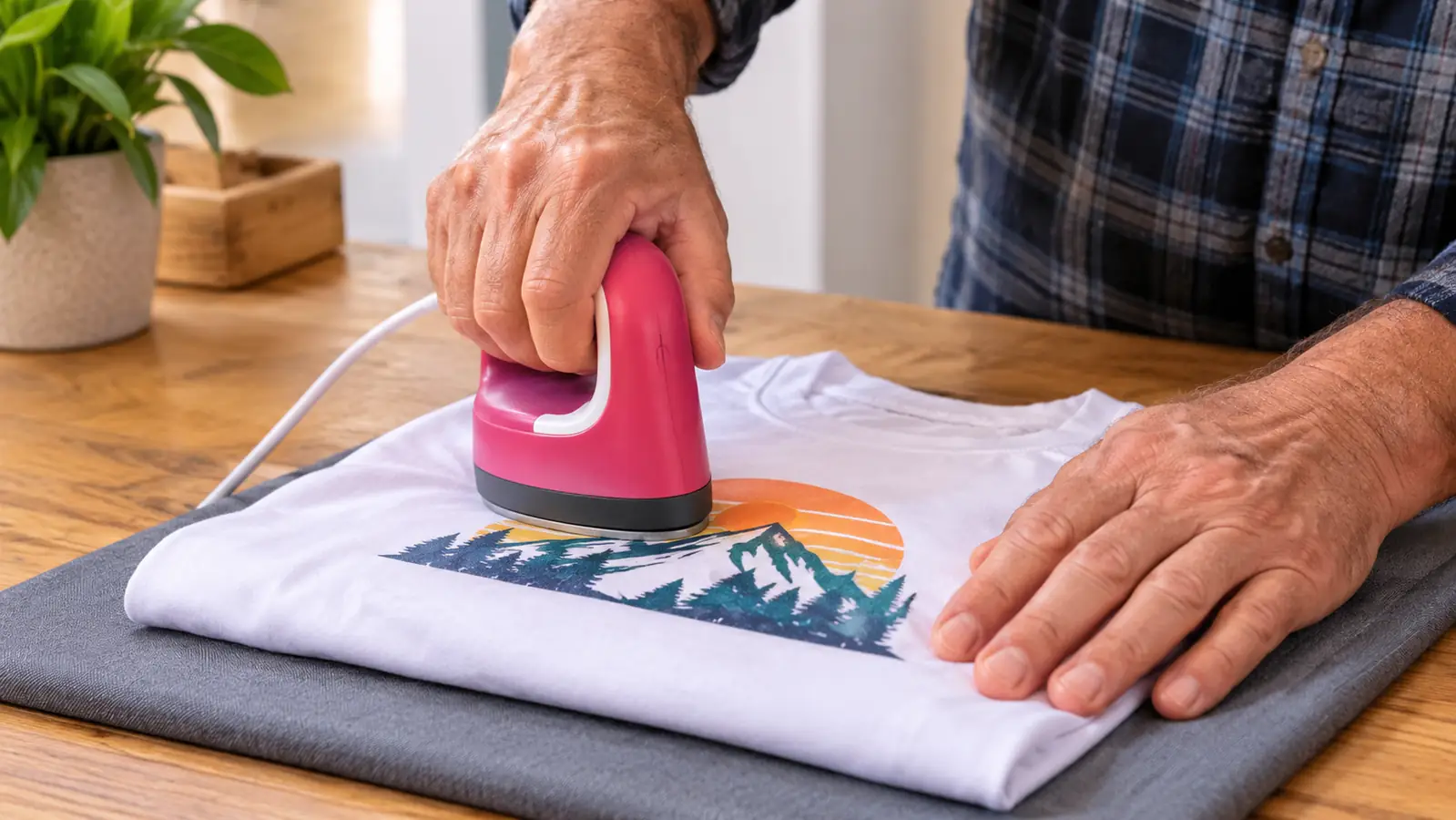
Coverage. There is no way around this one. If you are pressing a full back design on a youth jersey, an iron covers it in a pass or two. The Mini covers a patch roughly the size of your palm, so a big design becomes a grid of overlapping presses, and every place the grid lands unevenly shows up later as a dull patch in the vinyl. For anything wider than a name or a small chest logo, the iron is faster and more forgiving, and pretending otherwise would be silly. That is the single honest reason I still keep mine within reach when a big order comes in.
The iron also wins on the fact that it is already in your house, and it does more than press vinyl. Mine still handles work shirts, curtain hems and the sewing projects I drag out twice a year. A heat press does exactly one job and does nothing at all about the rest of your life. If you press four shirts a year for a birthday, a decent iron, a sheet of parchment and a hard flat surface will get you a result most people would never question. I would not have believed that four years ago, but I have looked back at my own early shirts and they held up better than I remembered.
Press Six Shirts in the Time It Used to Take to Argue With One
The Cricut EasyPress Mini holds the temperature the Cricut Heat Guide gives for your blank, so the sixth shirt looks like the first. Insulated safety base, auto-off, and small enough to live in a drawer when the evening is over.
Amazon Check Today's Price on Amazon →What Four Years of Pressing Taught Me
My first year was an iron, a pillowcase and a lot of hope. I pressed staff shirts for the school office holiday lunch, and they looked fine coming out of the stack. By the second wash the corners of the lettering had lifted and a few had curled. So I pressed them again, harder, and got a shiny patch where the plate sat too long in one spot. That shine does not come out. I threw two of those shirts away and quietly hoped nobody remembered which two they were, and I started reading about why instead of how hard.
The fix was not technique, or at least not only technique. It was steady heat. The difference between the right temperature held steady and almost the right temperature swinging around is the difference between an adhesive that melts into the weave of the fabric and one that half melts and lets go in the first wash. A thermostat iron walks through that range all evening without telling you, and you cannot see it happening. Once I understood that, the awkward questions stopped, and so did the second pass a week later.
What I actually changed was the order of my evening. With the iron I pressed one item at a time, start to finish, and each one was a small negotiation with an appliance that had other plans. With the press I set up once, worked through the whole run, and turned everything off in one motion. Same blanks, same vinyl, same two hands. The work did not get easier. It got shorter, and it stopped coming back to me, which is the part that used to eat my weekends.
The Settings Question
People ask me what temperature to use and I always give the same answer: look it up. The Cricut Heat Guide lists a temperature and a time for the exact combination you are using, and it is more reliable than any number I could hand you, because it changes with the blank, the vinyl and how many layers you are pressing. The Mini tops out at 204 C, which covers everything I have ever put under it. I read the entry, I set it, I wait, I press for the count it gives me, and I let the whole thing cool before I peel.
The iron has no equivalent, which is not a knock on irons. You get a dial marked with dots, a fabric chart older than I am and a lot of feel. Some people are excellent at that. My mother could press a crease into a pair of slacks with an iron and a damp cloth like she came out of the womb doing it. I am not my mother, and my pressable items have adhesive on the back, which means the margin for error is narrower than a pair of slacks and the failure is more visible in public.
Every shirt I pressed with an iron needed a second pass at the corners a week later. The press ended that, and it ended the guessing.
What a Press Actually Changes About Your Evening
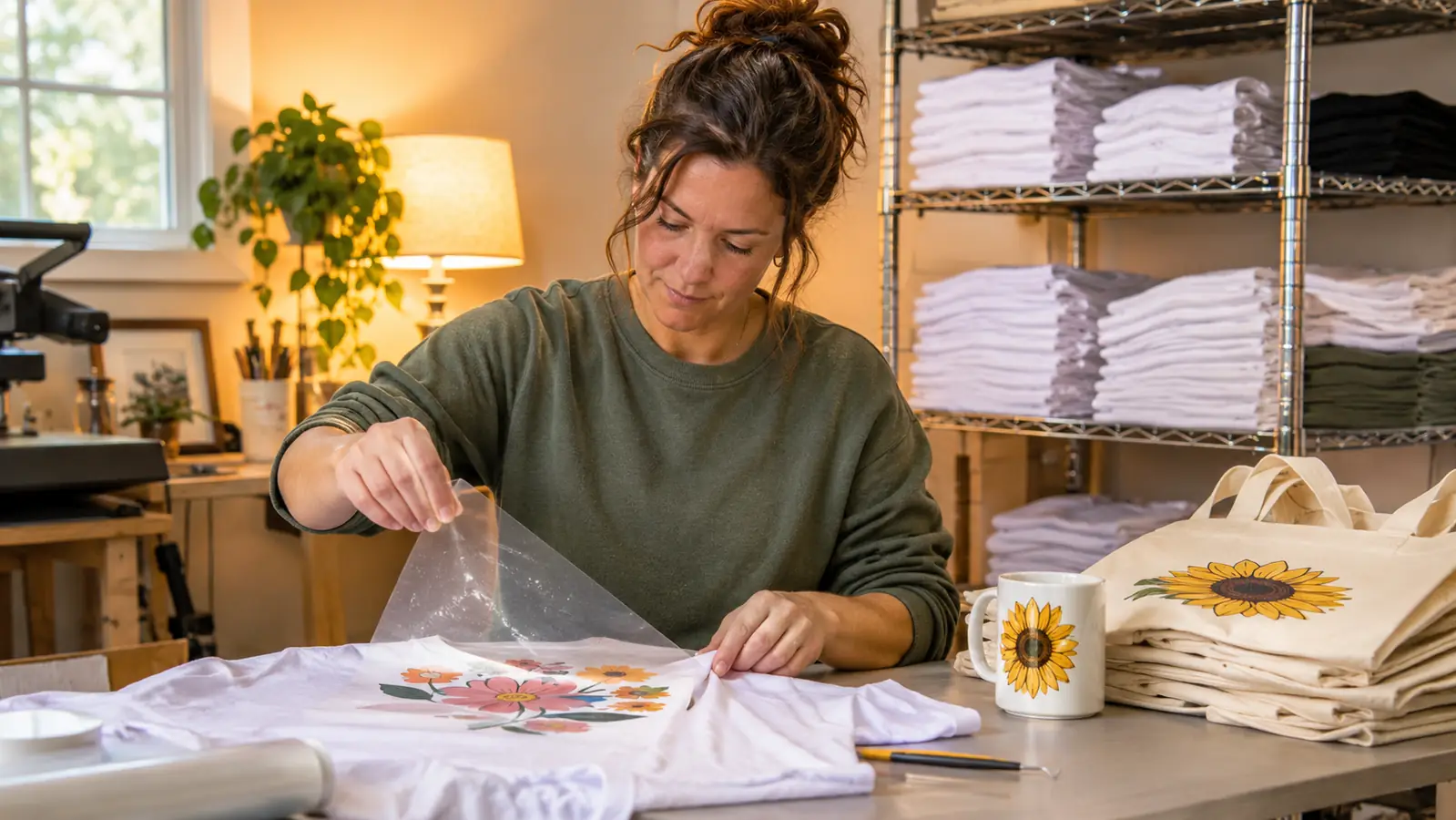
Six staff shirts used to eat an evening and a half. They take about forty minutes now, and most of that is waiting for the plate to come back up between presses. That is not a claim about making money, it is the reason I kept going with shirts and totes instead of quietly letting the whole thing become a hobby I used to have. The slow part of a small custom order is almost never the design work, which is the fun part. It is the pressing, and pressing badly costs you a blank and an hour.
There is also a floor below which better tools stop helping. If you hate the design side, a nicer press will not fix that. If the weeding knife work makes you want to lie down on the floor, no heat press on earth turns a Saturday afternoon into something you look forward to. What the press does is remove the specific frustration of doing everything right and still handing over a shirt that fails in the wash. That was the frustration that made me want to quit, so removing it was worth more to me than any feature on a spec sheet.
Where Each One Falls Short
The Mini's real limits are size and pressure. A small plate means overlap, and overlap means leaning your body weight through your hand for a few seconds at a time, over and over. On a long order my wrist notices by the end of the night. It also cannot do a full back print without that grid of passes, and if your grid is sloppy the vinyl tells everyone. And it is one more object on the wire shelf, backed by a one year limited warranty, so treat it like a tool and not an heirloom.
The iron's limits start with the holes. Steam holes leave marks in vinyl if you press straight onto them, which is why every tutorial tells you to use parchment or a pillowcase, which then dulls the heat and adds a variable you cannot measure. Add the cycling thermostat, the missing auto-off on most models, the upright-only resting position and the fact that you cannot get into a hat. It is a wonderful appliance and I would not want to iron a dress shirt without one. It is a poor heat press.
Who Should Buy Which
Buy the Mini if you are pressing hats, mugs, tote seams, small chest logos or names, or if you press more than a couple of items a month and want the fifth one to look like the first. It suits a spare-bedroom setup almost exactly, because it stores in a drawer, it comes with a base to set it down on, and it shuts itself off when the evening gets away from you. If your main work is youth jerseys with a full back design, buy the Mini for the numbers and the tight spots, and plan on a bigger plate for the backs.
Keep the iron if you press four items a year, if you have never had a shirt lift on you, or if a press would sit on the shelf while the iron stays plugged in on the board. There is no shame in that. I pressed with an iron for a year before I moved up, and I learned a lot about heat and pressure in that year, mostly by ruining things I had already paid for. My honest advice is to use what you have until it fails you twice, then buy the Mini and keep the iron for the curtains.
One Small Tool That Ends the Second Pass
The Cricut EasyPress Mini holds a set temperature, reaches into hat seams with a precision tip, and shuts itself off when the phone rings and the evening gets away from you. If you have been pressing everything with an iron, this is the upgrade you notice at the wash, not just on the first day.
Amazon Check Today's Price on Amazon →