
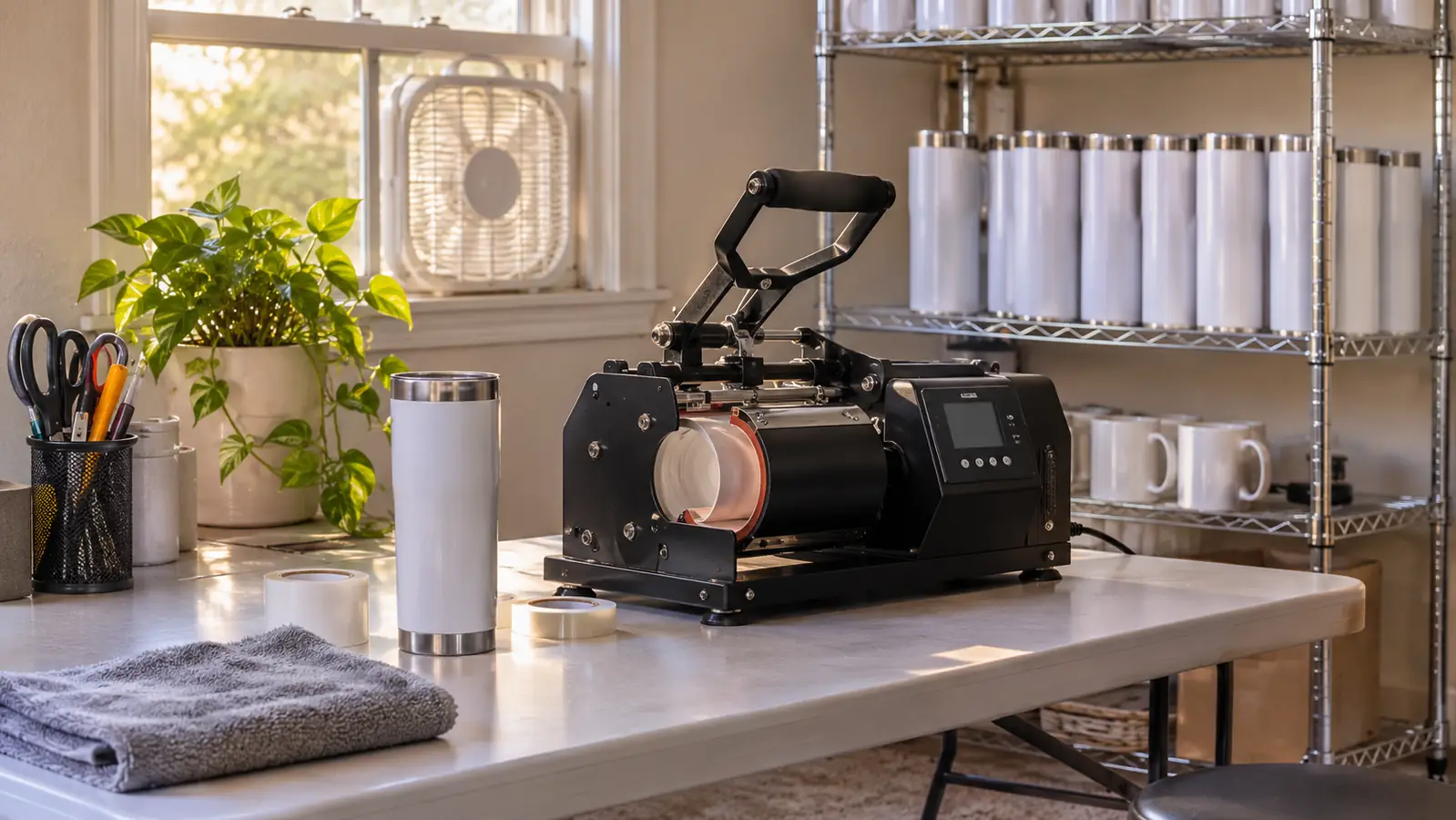
The first tumbler I ran through the HTVRONT Auto Tumbler Heat Press came out with a pale band around the lower third, like the ink had gotten tired halfway down and quit. That was my fault. I had loaded the wrap crooked and pressed it anyway because I was in a hurry to see the thing work. I have been pressing for about four years now, out of the spare bedroom of my house in Albuquerque, mostly shirts and totes for school staff and a church festival booth, and tumblers were the one job I kept turning down. The HTVRONT is the reason I stopped turning them down, and it is also the reason I now have a box of blanks under the shelf that I bought wrong.
What follows is not a love letter. It is the review I wish someone had handed me in the aisle at the craft store: what this machine does well, a shorter and more important list of what it will not do, and a plain answer to the question of whether you are the kind of buyer it suits. Read the sizing section first. If the blanks you use fall outside the window, nothing else in this review matters.
The Quick Verdict
A steady tumbler press with one genuine deal-breaker limit. Right for a dozen cups at a time in a small shop, wrong for anyone who needs speed or a wider range of blanks.
Amazon Check Today's Price →The one number that decides whether this press fits your shop
It holds tumblers from 2.9 to 3.2 inches in diameter, and 280ml to 850ml. Measure the blanks you actually own before anything else.
Amazon Check Today's Price on Amazon →What Nobody Tells You Before You Buy One
The listing says the machine holds tumblers from 2.9 inches to 3.2 inches in diameter, and from 280ml to 850ml. That is the whole ballgame, and it is the thing I glossed over when I was reading reviews at eleven at night, because everyone was busy talking about how much they loved theirs. Measure your blanks with a caliper. Not a ruler held up to the screen, and not the number in a product description that may or may not be the outside diameter. A case of blanks I bought last spring had three styles in it and two of them did not fit. The machine was fine. The blanks were wrong, and I had nobody to be annoyed at but myself.
The second thing nobody says out loud: this is one tumbler at a time. The heat pad closes around a single cup and stays there while it works. For a six piece order for a youth sports team, that is a completely reasonable pace. I can run six in an evening with a movie going on my laptop. For someone who wants to list forty tumblers and ship them on Monday, this is the wrong tool, and no amount of practice changes it. It is a side business machine. It is not a production line, and it does not pretend to be one.
Third, and this took me the longest to accept: the good results come from the wrap, the seam and the pressure, not from the machine being clever. The press gives you heat and a heat pad that closes evenly around the cup. It does not tell you that your wrap is a quarter inch off center. You find that out when you peel the paper and the design is listing to one side like a fence post. That is not a flaw in the design. It is just the job, and it is why I stopped blaming equipment around the second month.
The Limits, in Plain Terms
HTVRONT puts the upper temperature at 390°F and the lower at 210°F. That range covers what I actually do, which is sublimation on coated tumblers at around 365°F, and I have never needed the bottom of the range for drinkware. But some wrap instructions I have run into ask for more heat than 390°F, and when that happens I either follow the wrap maker's cooler, slower version or I accept that this is one job I cannot do on this machine. Find that out before you buy, because the press will not go there for you. The warranty is one year, which is ordinary for the category and worth writing on the calendar, because I have never once remembered a warranty until it was too late to use it.
The machine weighs 4.92 kg, just under eleven pounds, and measures 12.9 by 10.9 by 6.3 inches. That footprint fits on my long folding table with room left over for a cooling rack, which matters more than it sounds in a spare bedroom where the same table is also the shipping station. The shell is ABS, so it wipes clean when I get sloppy with the spray adhesive. It is light enough to shuffle from one end of the table to the other, but I would not carry it to a festival booth along with everything else I already haul. Mine stays put, and I like it that way.
What I Liked
- Fits a real work table at 12.9 by 10.9 by 6.3 inches, and weighs under five kilos
- Covers the blank sizes most small sellers use: 2.9 to 3.2 inches in diameter, 280ml to 850ml
- The R button halts the heat and releases the heat pad the moment you press it
- Simple enough that I taught a helper to run it in one sitting
- One year warranty, and a listing that states the size window instead of hiding it
Where It Falls Short
- One tumbler at a time, so a large order takes several evenings
- The 390°F ceiling rules out any process that wants to run hotter
- No help with wrap alignment, which is where most ruined blanks come from
- The 2.9 to 3.2 inch window will not fit every blank on the market
Somewhere around the thirtieth tumbler, the press stopped being the thing that limited me. After that it was my wrap seam and my patience, and neither one of those came in the box.
How I Actually Run a Tumbler
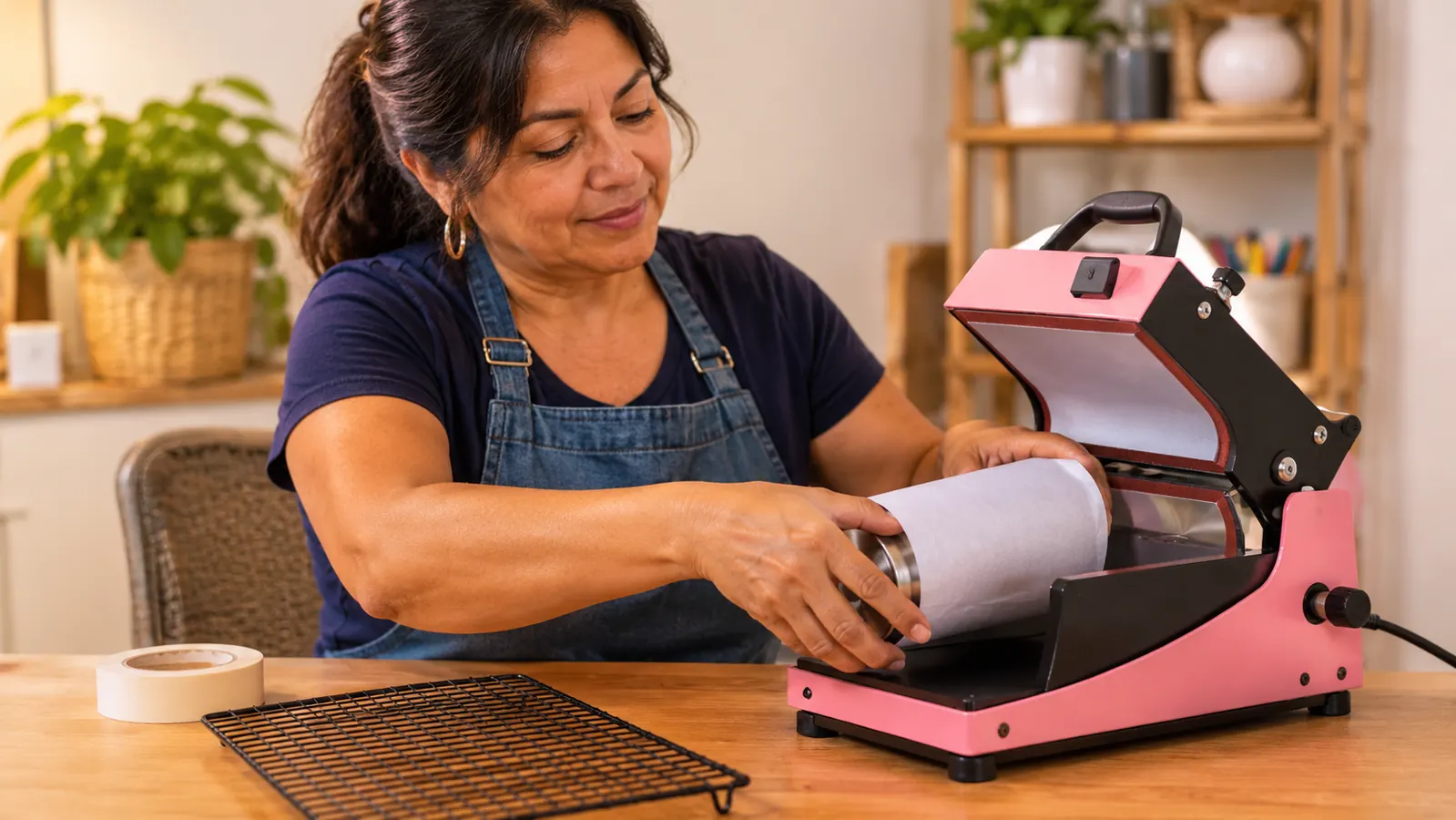
I wipe the tumbler down, wrap the print with the seam straight and tape it down, and set the press to 365°F. The pad closes around the cup and I let it sit for about a minute, then I press the R button, which halts the heat and releases the pad right away. That instant release is the feature I did not expect to care about and now would not give up. On my old setup I was sliding a hot cup out of a wrap with my heart in my throat. Here the pad lets go and I am not fighting it, and that alone has saved me more blanks than any other part of the process.
Then the cup cools completely before I peel. That is the step I skipped in the beginning and it cost me a whole batch with dull, washed out edges that I could not sell to anybody. Nothing about this machine rewards hurrying. The setting is simple, the button does exactly what the button says, and the rest of the job is in your hands and your patience and your willingness to wait ten minutes when you would rather not.
The machine draws 600 watts at 120 volts. On my circuit that is fine as long as I am not also running the window fan and a heat gun on the same outlet. I found that out the boring way, mid press, in the dark. If your press room is a spare bedroom sharing a circuit with the rest of the house, that is worth knowing before you set up, and it is the kind of thing almost nobody puts in a review because it is not really about the machine.
The Learning Curve Nobody Mentions
It took me about two weeks to stop wasting blanks. The first week I pressed everything too light because I was afraid of crushing the cup, and the prints came out faint and chalky. The second week I overcorrected and got one tumbler with a glossy, scorched look that I still keep on the shelf as a reminder. The machine did neither of those things to me. I did them, by guessing at settings instead of testing on a blank I did not care about. If you buy one, buy a few plain blanks along with it and treat them as tuition.
By the thirtieth tumbler I had a rhythm. Wipe, wrap, tape, press, wait, peel, inspect. It is maybe four minutes of actual work per cup plus the cooling time, which is fast enough for a team order and slow enough that I would not want to run forty in one night. The rhythm is what makes it feel like a real process instead of a craft project, and getting there cost me a handful of blanks and one ruined Sunday afternoon.
The part that surprised me is how little I use the temperature range. I found a setting that works for my blanks and my wraps and I have not moved off it in months. This is not a machine you fiddle with. It is a machine you learn once and then leave alone, which is exactly what I wanted from it, and it is why I eventually stopped reading tutorials and started just pressing.
What the 4.5 Stars Actually Tell You
The listing sits around 4.5 stars across roughly 2,450 ratings, and after living with the machine I think that number is fair rather than inflated. The complaints I went looking for mostly came down to the same two things I have already covered: the size window and the pace. People who expected to fit every blank on the market were disappointed. People who expected a production machine were disappointed. The people who fit the actual use case seem to be the ones leaving the high marks, which tracks with my own experience of it.
One thing I would say about reading reviews in general: a five star review written the day the box arrived tells you almost nothing. Look for the ones written after a few months. Look for the ones that mention a specific blank size, and the ones where the person says what they make. I ignored the reviewer who said it would not fit her blanks because I assumed I knew better. I did not know better, and that box under the shelf is the proof.
What It Changed for Me
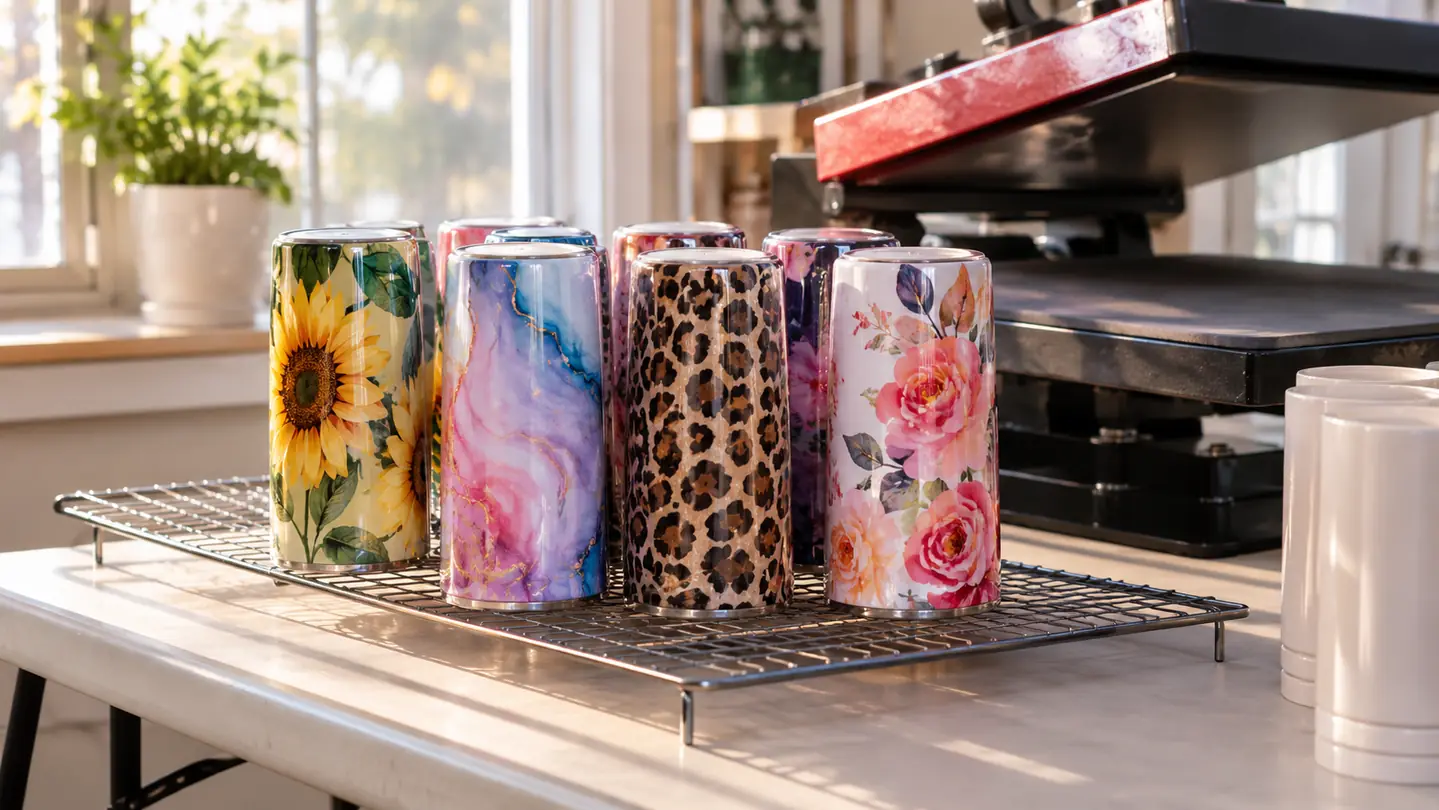
The Christmas order last year was eleven tumblers for school staff. I ran them across three evenings at the folding table, with the fan in the window and the wire shelf behind me slowly emptying out. Two of those people asked for a second one the following month. That is not a business, that is a good week, and it is exactly the size of job this press is built for. My teenage nephew helped me bag them, and even he could tell which ones I had rushed.
The honest version of what changed is not about money. It is that I stopped saying no. Before this, when someone asked about tumblers for a team or a staff gift, I said I did not do those and pointed them somewhere else. Now I say yes, and I know how long it will take and whether it will fit on the table. That is a small thing and it is the whole thing, because the reason I do any of this is that people ask.
If We Were Standing in the Craft Store Aisle
I would ask you three questions. What size are your blanks. How many do you need in a week. What temperature does your wrap maker call for. If the answers are 2.9 to 3.2 inches, under a dozen, and 390°F or below, buy it and get on with your evening. If any one of those answers is no, then the machine is not the problem and buying it will not solve anything. That is the entire decision, and it takes about ninety seconds once you have a caliper in your hand.
I would also tell you to buy the blanks first and the press second, which is backwards from how most people do it and is exactly why I have a box of unusable stock. And I would tell you that the first dozen will be worse than you expect and the second dozen will be better than you feared, and that this is normal. It is not a sign you bought wrong.
Who This Is For
Buy this if you already sell drinkware at a small scale, or you want to add tumblers to a shirt and tote lineup without sending the work out. It suits someone with a dedicated corner of a room, a steady but modest order flow, and the willingness to ruin three or four blanks while learning. It suits the church festival seller, the school staff gift maker, the person doing youth team cups a dozen at a time. The 2.9 to 3.2 inch window covers a lot of the blanks sold for exactly that market, and the small footprint means it does not take over the room it lives in.
Who Should Skip It
Skip it if the blanks you use fall outside 2.9 to 3.2 inches, because no amount of skill or practice fixes that. Skip it if you need volume, since one cup at a time will not clear a large order before a deadline. Skip it if your process wants more than 390°F. And skip it if you have never pressed anything and you are buying this to find out whether you like pressing at all, because a machine will not answer that question for you. A handful of blanks and a borrowed press will, and you keep the shelf space in the meantime.
If your blanks fit, this one earns its place on the table
2.9 to 3.2 inches in diameter, 280ml to 850ml, a one year warranty, and a heat pad that lets go the second you press R.
Amazon Check Today's Price on Amazon →